

HVAC System Market Projected to Reach USD 433.17 Billion by 2035, Growing at 5.89% CAGR
Heating Ventilation Air Conditioning Market
The Asia-Pacific region is emerging as the fastest-growing market, fueled by increasing urbanization and rising disposable incomes.
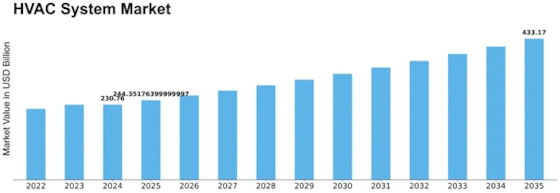
NEW YORK, NY, UNITED STATES, September 22, 2026 /EINPresswire.com/ -- As per Market Research Future analysis, the HVAC System Market Size was estimated at 230.76 USD Billion in 2024. The HVAC industry is projected to grow from 244.36 USD Billion in 2025 to 433.17 USD Billion by 2035, exhibiting a compound annual growth rate (CAGR) of 5.89% during the forecast period 2025 - 2035. This robust growth trajectory reflects the essential role of heating, ventilation, and air conditioning systems in modern buildings and industrial facilities, where climate control has become indispensable for occupant comfort, productivity, and health. The market's consistent expansion is underpinned by rapid urbanization, rising construction activity, increasing awareness of indoor air quality, stringent energy efficiency regulations, and the accelerating adoption of smart HVAC technologies that optimize performance and reduce energy consumption.Market Overview
HVAC systems encompass a comprehensive range of equipment and technologies designed to regulate temperature, humidity, air quality, and air circulation in residential, commercial, and industrial environments. The market includes cooling equipment such as air conditioners, chillers, and heat pumps, heating equipment including furnaces, boilers, and heating systems, and ventilation equipment comprising air handlers, fans, and ductwork. These systems collectively ensure thermal comfort, maintain healthy indoor air quality, and support critical processes across diverse building types, from single-family homes to large commercial complexes and industrial facilities.
The growth drivers for the HVAC market are diverse and mutually reinforcing. Rapid urbanization and construction activity stand as primary catalysts, as expanding cities require substantial HVAC installations across residential, commercial, and institutional buildings. The global construction industry continues to expand, driven by population growth, infrastructure investment, and modernization initiatives, creating sustained demand for HVAC equipment and services. The rising demand for energy-efficient HVAC systems is particularly pronounced, as building owners and operators seek to reduce operating costs and environmental impact while meeting increasingly stringent regulations.
Climate change and rising global temperatures are driving increased demand for cooling systems, particularly in regions that historically had limited air conditioning penetration. Extreme heat events are becoming more frequent and severe, compelling governments, businesses, and households to invest in reliable cooling solutions. Simultaneously, colder regions continue to require robust heating systems, maintaining steady demand for furnaces, boilers, and heat pumps.
Technological developments are reshaping the HVAC landscape at an accelerating pace. Smart HVAC systems integrating IoT sensors, artificial intelligence, and cloud connectivity are enabling real-time monitoring, predictive maintenance, and automated optimization of heating and cooling operations. These systems can learn occupant preferences, adjust to weather conditions, and integrate with building management systems to achieve significant energy savings. Variable refrigerant flow technology, inverter-driven compressors, and advanced controls are improving efficiency and performance across all equipment categories.
Environmental regulations and sustainability initiatives are transforming the HVAC industry. The phase-down of high-global-warming-potential refrigerants, including hydrofluorocarbons, is driving adoption of natural refrigerants and next-generation alternatives with lower environmental impact. Energy efficiency standards for HVAC equipment continue to tighten globally, pushing manufacturers to develop more efficient products. Building codes are increasingly mandating energy-efficient HVAC systems and renewable energy integration, creating favorable market conditions for advanced technologies.
The demand outlook for HVAC systems remains robust, supported by global construction activity, replacement cycles for aging equipment, and the continuous evolution of energy efficiency requirements. The HVAC Maintenance Services Market complements equipment sales by ensuring optimal system performance and longevity, with the services market estimated at 105.5 USD Billion in 2024 and projected to reach 130.8 USD Billion by 2035. The Automotive HVAC Duct Market demonstrates how HVAC technology extends beyond buildings into vehicle climate control systems, with that market estimated at 3.349 USD Billion in 2024 and projected to reach 4.778 USD Billion by 2035.
📍 Get Free Sample Report for Detailed Market Insights:
https://www.marketresearchfuture.com/sample_request/801
Market Segmentation
The HVAC system market is segmented based on equipment, sales channel, application, and regional analysis to provide a comprehensive understanding of the industry landscape.
By Equipment: The market is categorized into Cooling Equipment, Heating Equipment, and Ventilation Equipment. Cooling equipment represents the largest segment, driven by rising global temperatures, increasing air conditioning penetration in developing economies, and the growing demand for energy-efficient cooling solutions. This segment includes room air conditioners, split systems, packaged units, chillers, and heat pumps. Heat pumps are gaining significant traction as efficient alternatives to traditional heating and cooling systems, capable of both heating and cooling with high efficiency. Heating equipment follows closely, encompassing furnaces, boilers, and heating systems essential for occupant comfort in colder climates. Ventilation equipment, including air handling units, fans, and ductwork, is essential for maintaining indoor air quality and is increasingly integrated with smart building systems.
By Sales Channel: The market is divided into OEM and Aftermarket. The OEM segment dominates the market, driven by new construction activity and equipment replacement cycles. Manufacturers sell directly to contractors, distributors, and building owners, with equipment specified during building design and construction phases. The aftermarket segment encompasses replacement parts, components, and ancillary equipment, benefiting from the large installed base of HVAC systems globally. The aftermarket segment is growing as building owners seek to extend equipment lifespan through component replacement and upgrades.
By Application: The market is segmented into Residential, Commercial, and Industrial. The residential segment holds the largest share, driven by the vast number of households requiring heating and cooling solutions. Residential HVAC demand benefits from rising disposable incomes, urbanization, and increasing consumer awareness of energy efficiency and indoor comfort. The commercial segment represents a significant portion, encompassing office buildings, retail spaces, hotels, hospitals, and educational institutions. Commercial HVAC systems are typically larger, more complex, and require sophisticated controls and higher performance standards. The industrial segment covers manufacturing facilities, warehouses, data centers, and process industries requiring precise temperature and humidity control.
By Region: The market analysis covers North America, South America, Europe, Asia Pacific, and Middle East and Africa. Asia-Pacific dominates the global market, driven by massive construction activity, rapid urbanization, and expanding middle-class populations in China, India, and Southeast Asian nations.
🛒 You can buy this market report at:
https://www.marketresearchfuture.com/checkout?currency=one_user-USD&report_id=801
Regional Analysis
Asia-Pacific represents the largest and fastest-growing regional market for HVAC systems, driven by massive construction activity, rapid urbanization, and expanding middle-class populations. China leads the region as the world's largest HVAC market, supported by extensive residential and commercial construction, government initiatives promoting energy efficiency, and the rapid expansion of air conditioning penetration in both urban and rural areas. India is emerging as a significant growth market, driven by rising incomes, urbanization, and increasing awareness of indoor comfort. Japan and South Korea maintain strong demand for advanced, energy-efficient HVAC solutions, with high penetration rates and mature replacement markets. Southeast Asian nations, including Indonesia, Vietnam, and Thailand, are experiencing rapid HVAC adoption as economic development accelerates and air conditioning becomes more accessible.
North America remains a mature yet dynamic market, characterized by high HVAC penetration, substantial replacement demand, and strong emphasis on energy efficiency. The United States leads regional demand, driven by a large installed base of residential and commercial systems requiring replacement and upgrades. The region is at the forefront of smart HVAC adoption, with building owners and homeowners investing in connected systems that optimize energy consumption and improve comfort. Canada maintains steady demand, with HVAC systems essential for both heating and cooling across diverse climatic zones. The region's stringent energy efficiency regulations, including SEER and HSPF standards, are driving adoption of high-efficiency equipment.
Europe represents a technologically advanced market with strong emphasis on sustainability, energy efficiency, and environmental regulations. Germany leads regional consumption with its dominant construction and manufacturing sectors, home to leading HVAC manufacturers including Viessmann, Vaillant, and Bosch Thermotechnology. The European Union's Energy Efficiency Directive and renewable energy targets are driving investment in heat pumps, solar thermal systems, and other sustainable HVAC solutions. The region is at the forefront of the transition away from fossil fuel heating, with countries including Norway, Sweden, and Germany promoting heat pump adoption through incentives and regulations. The F-gas regulation is accelerating the transition to natural refrigerants.
South America and Middle East & Africa represent emerging markets with substantial growth potential. South American markets, particularly Brazil, show steady growth supported by construction activity and increasing HVAC adoption. The Middle East demonstrates strong demand for cooling systems driven by extreme climate conditions, with the Gulf Cooperation Council countries representing a significant market for high-capacity cooling solutions. Africa holds potential as urbanization accelerates, economic development progresses, and air conditioning penetration increases from low bases.
Competitive Landscape and Key Players
The HVAC system market is characterized by intense competition, featuring a mix of global manufacturers, regional players, and emerging innovators. Leading companies are focusing on strategic partnerships, technological innovation, capacity expansion, and portfolio diversification to strengthen their market positions.
Key players operating in this space include Carrier, Daikin Industries, Johnson Controls, Trane Technologies, Mitsubishi Electric, LG Electronics, Samsung Electronics, Panasonic Corporation, Lennox International, Rheem Manufacturing, Goodman Manufacturing, York International, and Nortek Global HVAC. These industry leaders leverage extensive manufacturing capabilities, global distribution networks, and strong brand recognition to maintain dominant market positions.
Strategic developments are reshaping the competitive landscape. Major manufacturers are investing in heat pump technology, variable refrigerant flow systems, and smart HVAC platforms. Acquisitions and mergers are consolidating market presence, enabling companies to expand product portfolios and geographic reach. The competitive landscape is moderately concentrated, with leading players exerting significant influence over pricing and technology standards. Companies are increasingly focusing on sustainability and energy efficiency as key differentiators.
Innovation and technology initiatives are accelerating across the industry. Manufacturers are developing HVAC systems with enhanced energy efficiency, reduced refrigerant charge, and improved connectivity. The integration of AI and machine learning is enabling predictive maintenance, automated optimization, and personalized comfort control. Digital twin technology is enabling virtual commissioning and performance optimization before physical installation.
Latest Industry News and Developments
Recent industry developments reflect the dynamic nature of the HVAC market. The phase-down of high-GWP refrigerants continues to drive innovation, with manufacturers introducing products using R-32, R-290, and other lower-GWP alternatives. Regulatory frameworks including the EU F-gas regulation and the US AIM Act are accelerating this transition, creating both challenges and opportunities for equipment manufacturers.
Heat pump adoption is accelerating across Europe and North America, driven by government incentives, environmental regulations, and consumer awareness of energy efficiency benefits. Major manufacturers are expanding heat pump production capacity and introducing new models optimized for cold climate performance. The technology is increasingly viewed as a key enabler of building decarbonization.
Smart HVAC integration continues to advance, with manufacturers introducing systems that leverage IoT sensors, cloud analytics, and AI to optimize performance and reduce energy consumption. These systems can integrate with building management platforms, renewable energy systems, and demand response programs to maximize efficiency and reduce operating costs.
Market Challenges and Opportunities
The HVAC system market faces several challenges that could impact growth trajectories. High initial costs for advanced, energy-efficient systems present barriers to adoption, particularly in price-sensitive markets. The complexity of integrating HVAC systems with building controls, renewable energy, and smart grid infrastructure requires sophisticated engineering and commissioning. Supply chain disruptions, including semiconductor shortages and component availability issues, have challenged production schedules and delivery times.
Regulatory compliance across different regions adds complexity, requiring manufacturers to develop products that meet diverse efficiency standards, refrigerant regulations, and safety requirements. The transition to lower-GWP refrigerants requires significant investment in product redesign and manufacturing processes. Skilled labor shortages in installation and maintenance services constrain market growth in some regions.
Emerging opportunities are abundant in the evolving market landscape. The transition toward building decarbonization and net-zero emissions creates substantial demand for heat pumps, solar thermal systems, and other sustainable HVAC solutions. The growth of data centers and digital infrastructure is driving demand for precision cooling systems with high reliability and efficiency requirements.
The expansion of smart building technologies and IoT integration offers opportunities for HVAC manufacturers to differentiate through connectivity, analytics, and service offerings. The growing awareness of indoor air quality, accelerated by the pandemic, is creating demand for ventilation and air purification solutions that improve occupant health and wellbeing. Emerging markets present significant growth potential as urbanization accelerates and HVAC penetration increases.
Future growth potential remains strong, driven by global construction activity, climate change adaptation, energy efficiency requirements, and the transformation of buildings toward smart, sustainable platforms. As building owners and operators increasingly prioritize efficiency, comfort, and environmental responsibility, demand for advanced HVAC solutions will continue to grow.
To explore more market insights, visit us at:
https://www.marketresearchfuture.com/reports/heating-ventilation-air-conditioning-market-801
Final Market Summary
The HVAC system market is poised for substantial growth, driven by urbanization, climate change, energy efficiency requirements, and technological innovation. The market's progression from 244.36 USD Billion in 2025 to 433.17 USD Billion by 2035 reflects the essential role of HVAC systems in modern buildings and the increasing demand for comfortable, healthy, and efficient indoor environments.
The long-term industry potential remains promising, with advancements in heat pump technology, smart controls, and sustainable refrigerants continuing to expand the possibilities for HVAC system design and functionality. The convergence of HVAC, renewable energy, and smart building technologies is enabling unprecedented levels of efficiency, comfort, and environmental responsibility. The transition toward building decarbonization represents a fundamental shift in the industry, positioning HVAC systems as critical enablers of sustainable, efficient buildings.
Key factors expected to influence future development include the pace of building construction and renovation, advancements in refrigerant and heat pump technologies, and the evolution of energy efficiency regulations. Consumer preferences for comfortable, healthy, and efficient indoor environments will continue to drive innovation across all HVAC segments. The ongoing digitalization of building systems and the integration of predictive analytics will create new opportunities for performance optimization and operational efficiency.
The transition toward smart, sustainable buildings represents a fundamental shift in construction and building operations, positioning HVAC systems as central to meeting global challenges including climate change, energy security, and public health. As building owners and operators increasingly prioritize efficiency, comfort, and environmental responsibility, the importance of sophisticated HVAC solutions will only continue to grow, ensuring robust demand and market expansion throughout the forecast period and beyond.
More Related Reports from MRFR Library:
Advanced Driver Assistance Systems Market: https://www.marketresearchfuture.com/reports/advanced-driver-assistance-systems-market-4434
Tire Pressure Monitoring System Market: https://www.marketresearchfuture.com/reports/tire-pressure-monitoring-system-market-4636
Hydrogen Fuel Cell Vehicle Market: https://www.marketresearchfuture.com/reports/hydrogen-fuel-cell-vehicle-market-4722
Electric Vehicle Battery Market: https://www.marketresearchfuture.com/reports/electric-vehicles-battery-market-4810
Automotive Adaptive Cruise Control Market: https://www.marketresearchfuture.com/reports/automotive-adaptive-cruise-control-market-4858
Automotive E Drive Market: https://www.marketresearchfuture.com/reports/edrive-automotive-market-5073
Transmission Repair Market: https://www.marketresearchfuture.com/reports/transmission-repair-market-5078
Transfer Case Market: https://www.marketresearchfuture.com/reports/transfer-case-market-5088
Mountain Bikes Market: https://www.marketresearchfuture.com/reports/mountain-bike-market-5165
E Scooters Market: https://www.marketresearchfuture.com/reports/e-scooters-market-5209
Market Research Future
Market Research Future
+1 855-661-4441
email us here
Legal Disclaimer:
EIN Presswire provides this news content "as is" without warranty of any kind. We do not accept any responsibility or liability for the accuracy, content, images, videos, licenses, completeness, legality, or reliability of the information contained in this article. If you have any complaints or copyright issues related to this article, kindly contact the author above.
