

Rat Model Market Valued at US$ 1.6 Bn in 2026, Rising to US$ 2.5 Bn by 2033 | Persistence Market Research
rat model market
Global rat model market driven by pharma research, gene editing advances, and rising demand for preclinical testing and disease modeling applications.
LONDON, UNITED KINGDOM, March 31, 2026 /EINPresswire.com/ -- The global rat model market is projected to reach a value of US$ 1.6 billion in 2026 and is expected to grow to US$ 2.5 billion by 2033, registering a compound annual growth rate (CAGR) of 6.9% during the forecast period. This steady expansion is driven by increasing investments in pharmaceutical research and development, rapid advancements in biotechnology, and evolving regulatory frameworks that support improved preclinical testing approaches. Within the broader animal model market, rat models hold a significant share due to their extensive use in drug discovery, toxicology testing, and disease modeling.
Rat models are highly valued for their physiological similarity to humans, ease of handling, and cost-effectiveness, making them indispensable in preclinical research. The growing demand for reliable and reproducible experimental results has further strengthened their adoption across pharmaceutical, biotechnology, and academic research institutions.
Download Your Free Sample & Explore Key Insights: https://www.persistencemarketresearch.com/samples/33949
Market Dynamics
One of the primary drivers of the rat model market is the continuous rise in global pharmaceutical R&D spending. Companies are allocating substantial resources toward drug discovery, safety evaluation, and therapeutic validation. Rat models play a critical role in these processes, particularly in regulatory-mandated preclinical studies. Their ability to support large-scale experiments and provide robust statistical data makes them a preferred choice over other animal models.
Technological advancements, especially the emergence of CRISPR/Cas9 genome editing, have revolutionized the development of rat models. This technology enables faster and more precise genetic modifications compared to traditional embryonic stem cell methods. As a result, development timelines have been reduced from over a year to just a few months, while also lowering costs significantly. Newer techniques such as GONAD (oviductal nucleic acid delivery) further enhance efficiency by enabling in vivo genome editing without complex procedures.
Despite these advancements, the market faces notable restraints. Regulatory changes promoting alternative testing methods, such as in vitro systems and computational modeling, are gradually reducing dependence on animal models. Ethical concerns surrounding animal experimentation have also intensified, leading to stricter compliance requirements. These factors increase operational complexity and may limit market growth, particularly in regions with stringent regulatory environments.
Opportunities in Emerging Applications
Significant opportunities are emerging in rare disease research and personalized medicine. Increasing focus on developing treatments for rare conditions has created demand for highly specialized rat models that replicate specific genetic mutations. These models are essential for understanding disease mechanisms and evaluating targeted therapies.
Personalized medicine is another promising area, where genetically tailored rat models are used to simulate patient-specific conditions. Advances in gene editing technologies allow researchers to create precise disease models, enabling more accurate drug testing and improving treatment outcomes. These niche applications are expected to drive premium demand and contribute to market expansion.
Get Custom Insights Designed for Your Businecss: https://www.persistencemarketresearch.com/request-customization/33949
Category-wise Analysis
In terms of model type, outbred rat strains such as Sprague-Dawley and Wistar dominate the market. These models are widely used in toxicology and safety studies due to their genetic diversity and high reproducibility. Their widespread acceptance in regulatory testing further reinforces their leading position.
From a technology perspective, microinjection remains the dominant method for genome editing, accounting for a significant share of the market. This technique allows direct modification of embryos, enabling rapid generation of transgenic models. However, CRISPR-based methods are rapidly gaining traction due to their efficiency, accuracy, and cost advantages, gradually replacing older technologies.
Regional Insights
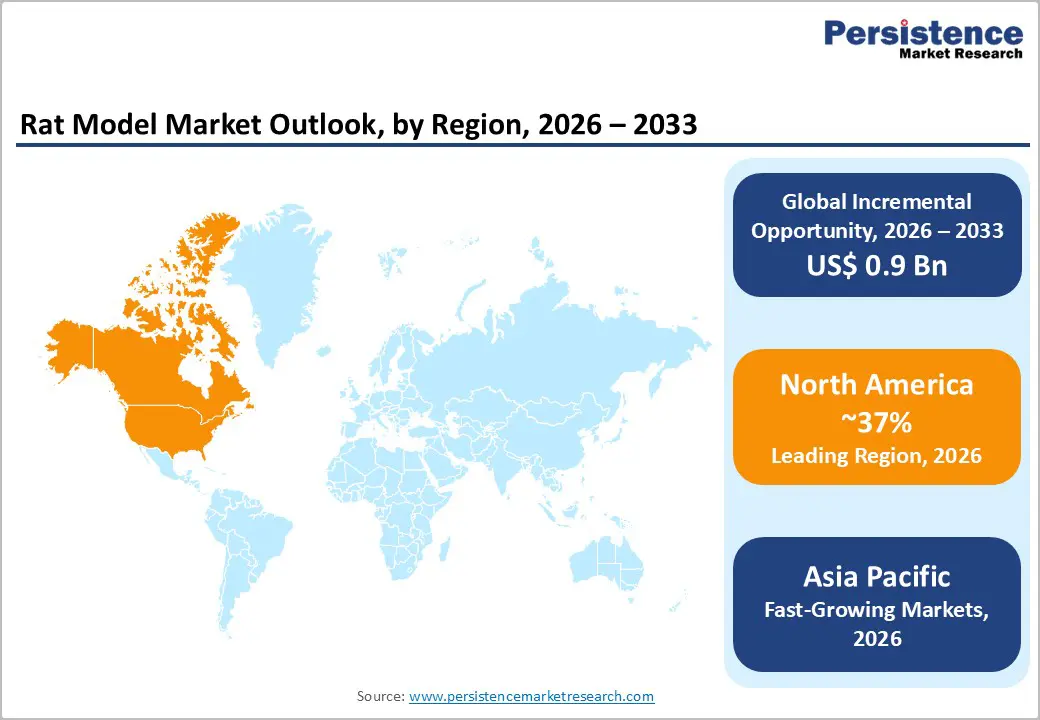
North America continues to lead the global rat model market, supported by a well-established research infrastructure, strong funding, and the presence of major pharmaceutical and biotechnology companies. The region’s focus on innovation and early adoption of advanced technologies ensures sustained demand for high-quality rat models.
Asia Pacific is emerging as the fastest-growing region, driven by expanding pharmaceutical manufacturing, increasing research investments, and growing contract research activities. Countries such as China and India are playing a key role in this growth, offering cost advantages and a rapidly developing research ecosystem. Government initiatives and rising healthcare needs are further accelerating market expansion in the region.
Competitive Landscape
The rat model market is moderately consolidated, with key players focusing on innovation, genetic expertise, and customized model development. Companies are investing in advanced gene-editing technologies and forming strategic collaborations to strengthen their market position. As demand for specialized models increases, competition is expected to intensify, driving further advancements and improving accessibility across the research community.
Checkout Now & Download Complete Market Report: https://www.persistencemarketresearch.com/checkout/33949
Market Segmentation
By Model Type
Knockout
Outbred
Inbred
Hybrid
Immunodeficient
Conditioned
By Technology
Nuclear Transferase
Microinjection
Embryonic Stem Cell
Others (CRISPR, GONAD, Base Editing)
By Application
Oncology
Neurology
Immunology
Toxicology
Other
By End User
Contract Research Organizations (CROs)
Academic and Research Institutes
Pharmaceutical & Biotechnology Companies
By Regions
North America
Europe
East Asia
South Asia & Oceania
Latin America
Middle East & Africa
Read Related Reports:
Interventional Pulmonology Market: The interventional pulmonology market will grow from US$1.4 Bn in 2026 to US$1.9 Bn by 2033 (4.2% CAGR), driven by rising COPD and lung disease care.
Healthcare Clinical Analysis Market: Global healthcare clinical analytics market grows from US$15.4 billion in 2026 to US$36.7 billion by 2033, expanding at a CAGR of 13.3%.
Persistence Market Research
Persistence Market Research Pvt Ltd
+1 646-878-6329
email us here
Visit us on social media:
LinkedIn
Instagram
Facebook
YouTube
X
Legal Disclaimer:
EIN Presswire provides this news content "as is" without warranty of any kind. We do not accept any responsibility or liability for the accuracy, content, images, videos, licenses, completeness, legality, or reliability of the information contained in this article. If you have any complaints or copyright issues related to this article, kindly contact the author above.
