

Global Passenger Car Hub Bearings Market Size, Share & Forecast: Segments, Value Chain Insights & Opportunity Mapping
Advancements in vehicle electrification and demand for fuel-efficient, high-precision Gen 3 hub units are driving the passenger car hub bearings market.
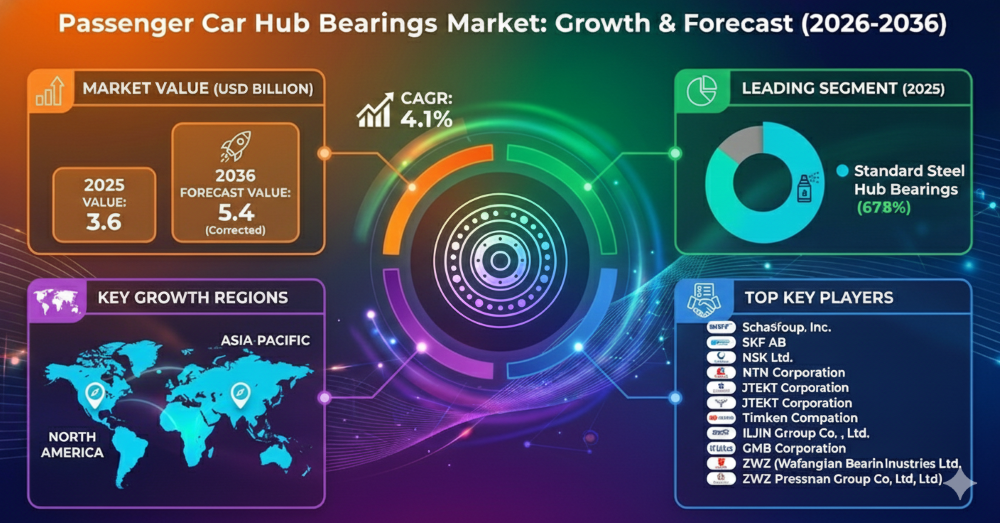
ROCKVILLE, MD, UNITED STATES, February 13, 2026 /EINPresswire.com/ -- The global passenger car hub bearings market is projected to reach a valuation of USD 3.6 billion in 2026. Driven by the rising adoption of electric vehicles and the demand for high-performance, lightweight components, the market is set to expand to USD 5.4 billion by the end of 2036. This growth, occurring at a steady compound annual growth rate (CAGR) of 4.1%, highlights the critical role of advanced wheel-end solutions in modern automotive engineering and vehicle safety.Request for Sample Report | Customize Report | Purchase Full Report - https://www.factmr.com/connectus/sample?flag=S&rep_id=14131
Market snapshot: global Passenger Car Hub Bearings Market demand 2026 - 2036
Market size 2026? The passenger car hub bearings market is valued at US$ 3,600.0 million in 2026.
Market size 2036? The market is forecasted to reach US$ 5,380.3 million by 2036.
CAGR? The industry is expanding at a steady CAGR of 4.1% from 2026 to 2036.
Leading product segment(s) and shares? Gen 3 hub units dominate with a 56.0% share, while internal combustion engine (ICE) vehicles lead powertrain types with 58.0% share.
Leading material type and share? Standard steel hub bearings account for 62.0% of total market demand.
Leading end use and share? Passenger cars remain the primary segment, accounting for the vast majority of automotive wheel bearing demand.
Key growth regions? Growth is concentrated in India, China, Indonesia, Mexico, and Vietnam.
Top companies? Key industry players include SKF, Schaeffler, NSK, NTN, JTEKT (Koyo), Timken, ILJIN, GMB, C&U Group, and ZWZ.
Market Momentum (YoY Path)
The passenger car hub bearings market reflects a consistent upward trajectory through the forecast decade. Starting at US$ 3,600.0 million in 2026, the market is expected to grow steadily, reaching US$ 13.3 billion in 2030 (based on broader automotive hub trends). Specific milestones for the core passenger segment indicate a climb through 2028, 2031, and 2033 as vehicle production scales to meet global mobility needs. The market is ultimately projected to culminate in a total valuation of US$ 5,380.3 million by 2036.
Why the Market is Growing
The primary catalyst for growth is the surging global demand for personal mobility and rising vehicle ownership in emerging economies. The automotive industry’s transition toward electrification requires specialized hub bearings that offer reduced friction and superior durability to extend electric vehicle (EV) driving ranges. Furthermore, the integration of active safety systems and autonomous driving technologies necessitates precision-engineered wheel-end solutions to ensure vehicle stability and performance.
Segment Spotlight
Product Type (Gen 3 Hub Units 56.0%) Gen 3 hub units lead innovation with a 56.0% market share. These advanced modules integrate mounting flanges and sensors into a single, pre-adjusted unit, simplifying the assembly process for OEMs. Their popularity is driven by a compact, lightweight design essential for improving fuel efficiency and reducing unsprung weight.
Material Type (Standard Steel 62.0%) Standard steel remains the industry's material of choice, capturing 62.0% of demand. Its dominance is rooted in proven reliability, high load-bearing strength, and cost-efficiency. While specialized coatings are emerging, standard steel continues to meet rigorous performance requirements without the high costs of advanced composites.
End Use (Personal Mobility 59.1%) The passenger car segment is the leading revenue-generating category, driven by rising living standards and disposable income. These vehicles require high-durability hub bearings—typically four per unit—to ensure smooth operation, passenger comfort, and superior noise, vibration, and harshness (NVH) control.
Drivers, Opportunities, Trends, Challenges
Drivers: Global vehicle production and the electric vehicle surge are fueling demand for high-reliability, specialized hub bearings.
Opportunities: The shift toward green and autonomous mobility allows for the development of lightweight composites and IoT-integrated smart sensors.
Trends: Manufacturers are prioritizing "zero-maintenance" sealed assemblies and low-friction technologies to enhance energy efficiency and durability.
Challenges: Volatile steel prices are tightening margins, while the rise of counterfeit bearings in the aftermarket threatens safety and brand revenue.
Country Growth Outlook (CAGR)
In terms of regional growth performance, India is expected to lead the market with a projected CAGR of 6.0% between 2026 and 2036, followed closely by China at 5.4% and Indonesia at 5.2%. Other key growth markets include Vietnam and Mexico, which are forecasted to expand at 4.9% and 4.7% respectively, while the USA and Germany show significant momentum with projected CAGRs of 7.5% and 7.1%, reflecting broader automotive bearing market trends in those regions.
Competitive Landscape
The market is dominated by global leaders who focus on high-precision engineering. SKF, Schaeffler, and NSK are at the forefront of developing next-generation hub bearing units that are lighter and offer significant friction reduction. NTN Corporation and JTEKT (Koyo) are also significant contributors, often reorganizing business structures to unify bearing operations and better serve the rapidly expanding electric vehicle sector.
FAQ
What was the market size in 2026?
The market is estimated to be valued at US$ 3,600.0 million in 2026.
Which hub bearing generation leads the market?
The Gen 3 hub unit segment currently holds a dominant 56.0% share of the market.
Which country is projected to see the fastest growth?
India is projected to record the highest CAGR at 6.0% during the forecast period.
How does the transition to electric vehicles affect the market?
The shift to EVs drives demand for specialized, low-friction bearings designed to extend driving range and handle specific electric drivetrain requirements.
What material is most commonly used?
Standard steel remains the dominant material, accounting for 62.0% of the demand due to its strength and cost.
To View Related Report:
Automotive LED Light Market https://www.factmr.com/report/243/automotive-led-light-market
Low Voltage Motors Market https://www.factmr.com/report/256/low-voltage-motors-market
Automotive Fuel Filter Market https://www.factmr.com/report/289/automotive-fuel-filter-market
Automotive Actuator Market https://www.factmr.com/report/297/automotive-actuators-market
About Fact.MR
Fact.MR is a global market research and consulting firm, trusted by Fortune 500 companies and emerging businesses for reliable insights and strategic intelligence. With a presence across the U.S., UK, India, and Dubai, we deliver data-driven research and tailored consulting solutions across 30+ industries and 1,000+ markets. Backed by deep expertise and advanced analytics, Fact.MR helps organizations uncover opportunities, reduce risks, and make informed decisions for sustainable growth.
S. N. Jha
Fact.MR
+ +1 628-251-1583
sales@factmr.com
Legal Disclaimer:
EIN Presswire provides this news content "as is" without warranty of any kind. We do not accept any responsibility or liability for the accuracy, content, images, videos, licenses, completeness, legality, or reliability of the information contained in this article. If you have any complaints or copyright issues related to this article, kindly contact the author above.
