

Schizophrenia Treatment Market to Reach US$12.1 Bn by 2033 | Persistence Market Research
schizophrenia treatment market
The schizophrenia treatment market is driven by advanced antipsychotics, long-acting injectables, digital therapeutics, and expanding global healthcare access.
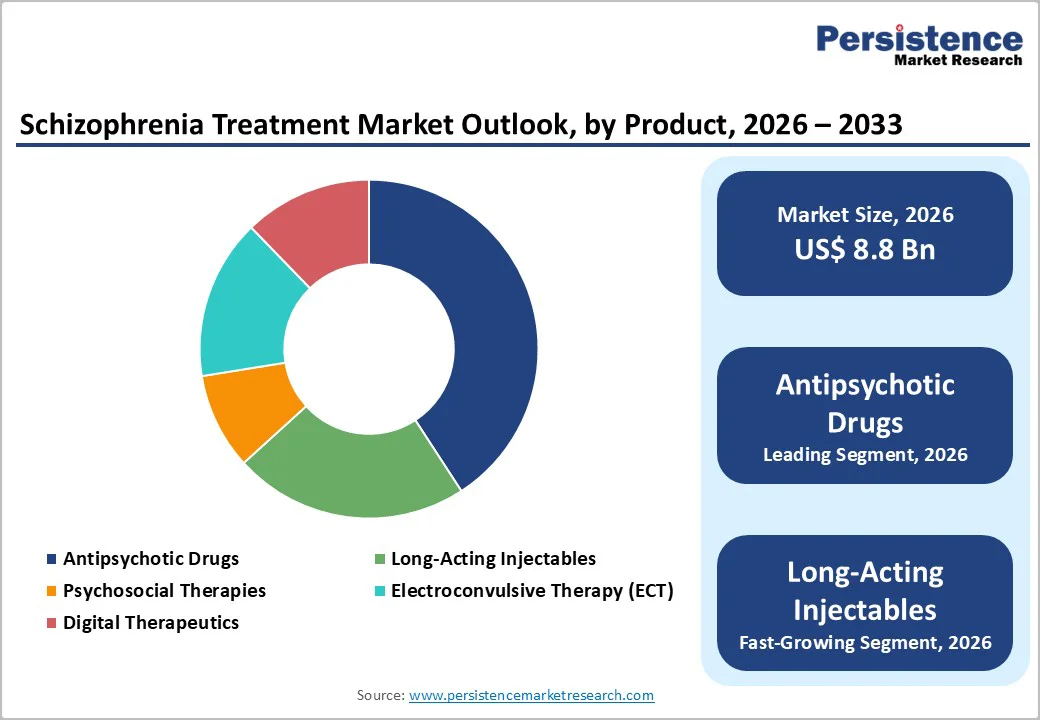
LONDON, UNITED KINGDOM, February 9, 2026 /EINPresswire.com/ -- The global schizophrenia treatment market is poised for significant growth, with its market size estimated at US$8.8 billion in 2026 and projected to reach US$12.1 billion by 2033, recording a compound annual growth rate (CAGR) of 4.6% over the forecast period. The market expansion is primarily driven by the rising prevalence of schizophrenia, improved access to diagnostic tools, and the increasing adoption of advanced long-acting antipsychotic formulations. Second-generation antipsychotics continue to be the standard of care due to their superior safety profile and efficacy compared to older drugs. Additionally, the growing preference for long-acting injectables (LAIs) has enhanced medication adherence and reduced relapse rates, leading to increased prescription volumes. Digital tools, telepsychiatry, and personalized therapies further strengthen disease monitoring and patient management.
Download Your Free Sample & Explore Key Insights: https://www.persistencemarketresearch.com/samples/22417
Key Industry Highlights
Second-generation antipsychotics dominate prescriptions due to improved tolerability, lower risk of extrapyramidal side effects (EPS), and better overall symptom control. Digital innovations such as telepsychiatry, medication reminder apps, remote counseling, and therapy platforms enhance patient adherence and engagement. The pharmaceutical pipeline is actively exploring alternative mechanisms, including glutamatergic pathways, serotonergic modulation, trace amine-associated receptor (TAAR) agonists, and inflammation-linked therapies. Antipsychotic drugs maintain the highest market share, serving as the primary and first-line standard of care for almost all diagnosed schizophrenia patients. Geographically, North America accounts for the largest share of the global schizophrenia treatment market, driven by advanced healthcare infrastructure, high diagnosis rates, and strong insurance coverage.
Market Dynamics
Driver – Shift Toward Long-Acting Injectables
The transition toward long-acting injectable antipsychotics is a key trend shaping the schizophrenia treatment market. LAIs address the critical challenge of medication non-adherence, which is common due to forgetfulness, side effects, or lack of insight into one’s condition. Administered at monthly, quarterly, or extended intervals, LAIs maintain consistent therapeutic levels, reduce relapse rates, and improve long-term outcomes. They also enable better monitoring by caregivers and healthcare providers, enhancing patient engagement and continuity of care. The convenience of fewer injections and reduced reliance on daily oral regimens encourages physician recommendation and patient acceptance. Consequently, pharmaceutical companies are investing heavily in developing and marketing LAIs, driving growth in the injectable antipsychotic segment.
Restraints – Limited Access to Psychiatric Care
Limited access to psychiatric care remains a critical restraint in the schizophrenia treatment market. Rural and semi-urban areas often lack trained psychiatrists, psychologists, and mental health specialists, resulting in delayed diagnosis, misdiagnosis, and under-treatment. Early intervention is essential for improved long-term outcomes, but many patients receive treatment only during acute episodes, leading to higher relapse rates and hospitalizations. Infrastructural limitations also impede administration of LAIs, monitoring of side effects, and provision of psychosocial therapies. This shortage of mental health professionals increases patient load in urban centers, creating overburdened systems and extended waiting times, ultimately restricting market growth.
Opportunity – Digital Therapeutics and Telepsychiatry
Digital therapeutics and telepsychiatry are transforming schizophrenia care by bridging gaps in access, adherence, and continuous monitoring. Mobile applications enable real-time tracking of symptoms, medication schedules, and mood, providing actionable insights for clinicians. AI-driven platforms detect early signs of relapse, allowing timely intervention before acute episodes. Telepsychiatry extends care to rural and underserved areas, providing virtual consultations, therapy sessions, and caregiver guidance. Personalized care plans, digital cognitive-behavioral programs, and tailored reminders complement pharmacological treatments while reducing stigma. Integration with electronic health records and predictive analytics enhances outcomes, reduces hospitalization rates, and creates scalable, data-driven management of schizophrenia.
Get Custom Insights Designed for Your Business: https://www.persistencemarketresearch.com/request-customization/22417
Region-wise Insights
North America
North America leads the global schizophrenia treatment market, supported by advanced healthcare infrastructure, high diagnosis rates, and insurance coverage. Second-generation antipsychotics dominate, and LAIs are increasingly used for treatment-resistant patients. Telepsychiatry and digital therapeutics enable remote monitoring and early interventions, particularly in rural areas. Government initiatives and awareness campaigns reduce stigma, encouraging timely treatment.
Asia Pacific
Asia Pacific is an emerging market, driven by rising awareness, improving healthcare infrastructure, and increasing diagnosis rates in countries such as China, India, and Japan. Second-generation antipsychotics and LAIs are gaining adoption, supported by expanding hospital networks and mental health programs. Telepsychiatry and digital solutions help bridge urban-rural gaps, while government and NGO initiatives enhance access and reduce stigma.
Checkout Now & Download Complete Market Report: https://www.persistencemarketresearch.com/checkout/22417
Competitive Landscape
The schizophrenia treatment market is highly competitive, emphasizing innovation, product differentiation, and access expansion. Companies focus on new antipsychotic drugs, LAIs, generics, and digital therapeutics to improve adherence and address treatment-resistant cases. Strategic collaborations, mergers, and regional expansions further strengthen market positioning. Recent approvals, such as Amneal Pharmaceuticals’ extended-release risperidone in 2025, exemplify innovation in injectable formulations. Key players include Johnson & Johnson, Eli Lilly, AstraZeneca, Otsuka, Alkermes, Bristol-Myers Squibb, H. Lundbeck, Pfizer, AbbVie, Teva, Sumitomo Pharma, Vanda Pharmaceuticals, GSK, Novartis, and Sanofi.
Market Segmentation
By Product Type
Antipsychotic Drugs
Long-Acting Injectables
Psychosocial Therapies
Electroconvulsive Therapy (ECT)
Digital Therapeutics
By Distribution Channel
Hospital Pharmacies
Drug Stores
Retail Pharmacies
E-Commerce
Others
By Region
North America
Europe
East Asia
South Asia and Oceania
Latin America
Middle East and Africa
The global schizophrenia treatment market is set to grow steadily, fueled by advancements in antipsychotic therapy, digital therapeutics, and healthcare infrastructure, while continued innovation and improved access will shape the future of patient care.
Read Related Reports:
Mental Health Software Market: The global mental health software market is set to grow rapidly from US$6.7B in 2025 to US$19.4B by 2032, at a CAGR of 16.4% during 2025–2032.
Osteoarthritis Treatment Market: Global osteoarthritis treatment market to reach US$15.3 Bn by 2032, driven by rising disease cases and demand for advanced therapies and implants.
Persistence Market Research
Persistence Market Research Pvt Ltd
+1 646-878-6329
email us here
Visit us on social media:
LinkedIn
Instagram
Facebook
YouTube
X
Legal Disclaimer:
EIN Presswire provides this news content "as is" without warranty of any kind. We do not accept any responsibility or liability for the accuracy, content, images, videos, licenses, completeness, legality, or reliability of the information contained in this article. If you have any complaints or copyright issues related to this article, kindly contact the author above.
