

Global Electronic Differential Control Module Market Outlook 2036: Trends, Innovation Drivers & Growth Opportunities
Request for Sample Report | Customize Report |purchase Full Report - https://www.factmr.com/connectus/sample?flag=S&rep_id=14079
Redefining Traction: The Shift from Mechanical to Electronic
The Electronic Differential Control Module serves as the "brain" of a vehicle's drivetrain. Unlike traditional mechanical differentials that rely on physical gears and clutches to manage wheel speed differences, the EDCM utilizes real-time sensor data—including steering angle, throttle position, and individual wheel speeds—to electronically actuate locking mechanisms or adjust torque distribution.
The move toward software-defined vehicles has made these modules indispensable. In modern multi-motor EV configurations, EDCMs perform complex calculations to simulate or enhance differential functions, providing "virtual" locking that reacts faster than any mechanical equivalent. This transition not only reduces vehicle weight by eliminating heavy mechanical linkages but also significantly improves energy efficiency by minimizing unwanted wheel slip.
Market Dynamics: Who, What, and Why Now?
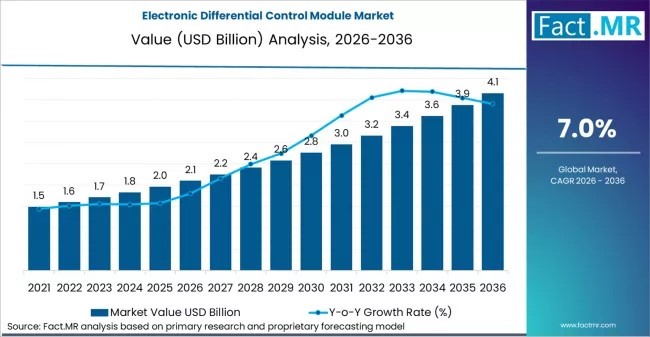
The surge in market value is attributed to several key industry drivers:
The EV Revolution: Battery-electric vehicles (BEVs) are the fastest-growing segment for EDCM adoption. Manufacturers are increasingly moving toward dual and quad-motor setups that require centralized electronic control to manage independent wheel torque.
Regulatory Pressures: Global safety mandates regarding Electronic Stability Control (ESC) and Advanced Driver Assistance Systems (ADAS) are forcing OEMs to integrate more responsive traction modules.
SUV & Crossover Dominance: With SUVs now representing nearly 50% of global passenger vehicle sales, the demand for All-Wheel Drive (AWD) systems—which rely heavily on electronic differentials for off-road and all-weather capability—has reached an all-time high.
Strategic Competitive Landscape
The market remains highly competitive, with established Tier-1 suppliers and technology disruptors vying for dominance. Key players currently leading the innovation curve include:
Bosch and Continental AG: Dominating the software-integrated safety and stability sector.
ZF Friedrichshafen AG and Eaton Corporation: Leading in highly integrated electric axle systems and specialized locking differentials.
GKN Automotive and American Axle & Manufacturing (AAM): Focusing on high-performance torque vectoring and e-Drive technologies.
Dana Incorporated: Expanding its footprint in both conventional and electrified planetary drive solutions.
Future Outlook: Zonal Architecture and AI Integration
Industry analysts point toward the next frontier: Zonal E/E (Electrical/Electronic) Architectures. By 2030, many OEMs are expected to migrate from dozens of distributed electronic control units (ECUs) to a centralized "zonal" layout. In this environment, the EDCM will evolve into a high-compute workload integrated within a primary vehicle controller, utilizing AI-driven predictive algorithms to anticipate road conditions before a slip even occurs.
"The electronic differential represents a shift from purely mechanical solutions to intelligent, software-driven vehicle dynamics," states a leading automotive analyst. "We are no longer just managing power; we are optimizing every millisecond of the driving experience for safety and efficiency."
About the Electronic Differential Control Module Market Report
This press release highlights data from the latest industry insights regarding Electronic Differential Lock (EDL) and Control Module trends. The comprehensive data covers market estimations, competitive profiling, and regional growth projections for the 2026–2032 forecast period, intended for investors, automotive OEMs, and strategic planners.
To View Related Report:
Automotive LED Light Market https://www.factmr.com/report/243/automotive-led-light-market
Low Voltage Motors Market https://www.factmr.com/report/256/low-voltage-motors-market
Automotive Fuel Filter Market https://www.factmr.com/report/289/automotive-fuel-filter-market
Automotive Actuator Market https://www.factmr.com/report/297/automotive-actuators-market
About Fact.MR
Fact.MR is a global market research and consulting firm, trusted by Fortune 500 companies and emerging businesses for reliable insights and strategic intelligence. With a presence across the U.S., UK, India, and Dubai, we deliver data-driven research and tailored consulting solutions across 30+ industries and 1,000+ markets. Backed by deep expertise and advanced analytics, Fact.MR helps organizations uncover opportunities, reduce risks, and make informed decisions for sustainable growth.
S. N. Jha
Fact.MR
+ +1 628-251-1583
sales@factmr.com
Legal Disclaimer:
EIN Presswire provides this news content "as is" without warranty of any kind. We do not accept any responsibility or liability for the accuracy, content, images, videos, licenses, completeness, legality, or reliability of the information contained in this article. If you have any complaints or copyright issues related to this article, kindly contact the author above.
