

Battery Swapping Charging Infrastructure Market Reach US$1. 48 Bn by 2032 Driven by Rapid EV Adoption and Urban Mobility
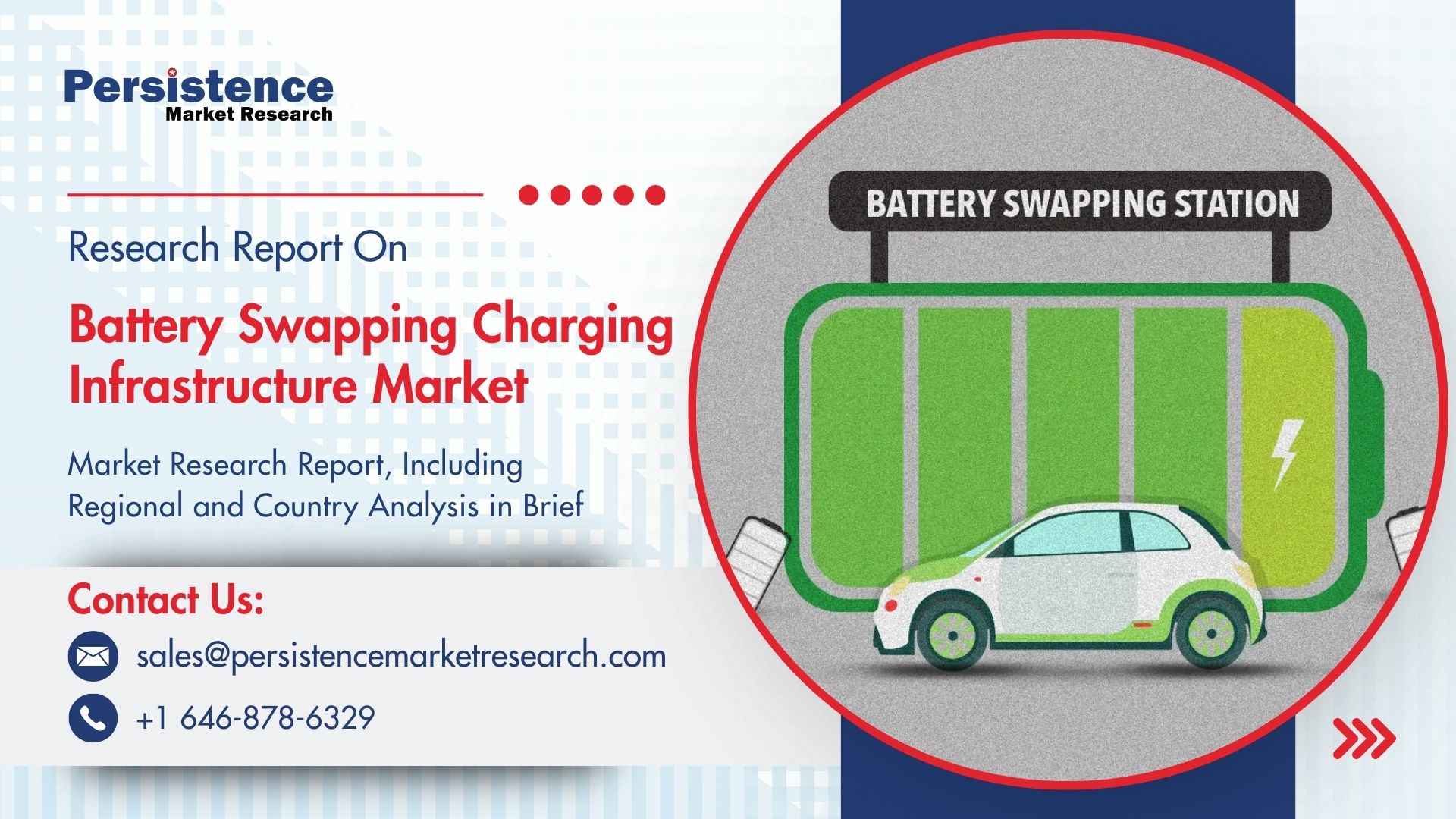
Battery Swapping Charging Infrastructure Market
Battery-as-a-Service is fueling battery swapping growth by lowering upfront EV costs and reducing financial barriers to adoption
LONDON, LONDON, UNITED KINGDOM, February 2, 2026 /EINPresswire.com/ -- The battery swapping charging infrastructure market is emerging as a transformative solution in the global electric vehicle (EV) ecosystem. According to the latest study by Persistence Market Research, the global battery swapping charging infrastructure market size is projected to rise from US$ 319.2 Mn in 2025 to US$ 1480 Mn by 2032, expanding at a robust CAGR of 24.5%. This exceptional growth trajectory is largely driven by increasing EV adoption, demand for faster charging alternatives, and supportive government policies aimed at reducing carbon emissions. Battery swapping eliminates long charging times by enabling users to exchange depleted batteries for fully charged ones within minutes, making it particularly attractive for urban mobility and commercial applications.
Get Your FREE Sample Report Instantly – Click Now: https://www.persistencemarketresearch.com/samples/35267
Rising EV Adoption Accelerating Market Growth
The rapid penetration of electric vehicles across developed and developing economies is a primary growth driver for the battery swapping charging infrastructure market. With concerns around climate change and fossil fuel dependency intensifying, governments are actively promoting EV adoption through subsidies, incentives, and infrastructure investments. Battery swapping offers a practical solution to one of the biggest EV challenges—range anxiety and charging downtime. This is especially beneficial for two-wheelers, three-wheelers, and fleet operators who require high vehicle uptime, thereby accelerating the adoption of swapping stations across dense urban centers.
Advantages of Battery Swapping Over Conventional Charging
Battery swapping infrastructure provides significant advantages over conventional plug-in charging systems. It drastically reduces charging time, improves vehicle utilization, and lowers upfront EV costs by allowing battery-as-a-service (BaaS) models. Users can purchase vehicles without batteries and subscribe to swapping services, reducing initial ownership costs. Additionally, centralized battery management enables better battery health monitoring, recycling, and second-life usage, making the model more sustainable and economically efficient in the long run.
Market Segmentation
By Vehicle Type
2-Wheelers
3-Wheelers
Passenger Vehicle
Commercial Vehicle
By Service Type
Subscription
Pay-per-use
By Application
Passenger
Commercial
By Region
North America
Europe
Asia Pacific
South Asia and Oceania
Latin America
Middle East and Africa
Get a Customized Market View in One Click: https://www.persistencemarketresearch.com/request-customization/35267
Dominance of Two- and Three-Wheelers in Urban Markets
Two-wheelers and three-wheelers currently dominate the battery swapping charging infrastructure market, particularly in Asia Pacific and South Asia regions. These vehicles are widely used for daily commuting, last-mile delivery, and shared mobility services. Battery swapping aligns perfectly with their operational requirements, offering quick turnaround times and lower operational costs. As urban congestion and fuel prices rise, electric two- and three-wheelers supported by swapping networks are becoming a preferred mobility solution.
Subscription and Pay-Per-Use Business Models
The market is witnessing strong traction for both subscription-based and pay-per-use service models. Subscription services are gaining popularity among fleet operators and commercial users due to predictable operating costs and uninterrupted access to charged batteries. Meanwhile, pay-per-use models appeal to individual users seeking flexibility without long-term commitments. This dual-model approach enhances customer adoption across diverse user segments and supports steady revenue generation for infrastructure providers.
Regional Insights and Emerging Opportunities
Asia Pacific leads the global battery swapping charging infrastructure market due to high EV penetration, dense urban populations, and proactive government initiatives in countries such as China, India, and Indonesia. Europe and North America are also witnessing growing investments, particularly for passenger vehicles and shared mobility fleets. Meanwhile, regions such as Latin America and the Middle East & Africa present untapped growth opportunities as EV adoption gains momentum and urban mobility challenges intensify.
Technological Advancements and Standardization Efforts
Ongoing technological advancements are shaping the future of battery swapping infrastructure. Innovations in modular battery design, automation, and AI-driven energy management systems are improving operational efficiency and scalability. At the same time, industry players are increasingly focusing on battery standardization to enable interoperability across vehicle brands. These efforts are expected to reduce infrastructure costs, accelerate deployment, and foster a more integrated EV ecosystem globally.
For In-Depth Competitive Analysis, Buy Now: https://www.persistencemarketresearch.com/checkout/35267
Company Insights
The battery swapping charging infrastructure market is highly competitive, with several global and regional players focusing on strategic partnerships, geographic expansion, and technology innovation. Key companies operating in the market include
✦ Nio
✦ Gogoro
✦ Ample
✦ Sun Mobility
✦ RACE Energy Ltd.
✦ Esmito Solutions Pvt. Ltd.
✦ Battery Smart
✦ IMMOTOR
✦ Battswap
✦ Swap Energi Indonesia
✦ Contemporary Amperex Technology Co., Ltd.
These players are actively investing in expanding swapping networks, enhancing battery technologies, and collaborating with automakers to strengthen their market position.
Future Outlook of the Battery Swapping Charging Infrastructure Market
Looking ahead, the battery swapping charging infrastructure market is poised for rapid expansion as EV adoption continues to surge worldwide. The combination of fast service, cost efficiency, and sustainability makes battery swapping an ideal solution for future mobility needs. With the market expected to reach US$ 1480 Mn by 2032, supported by a strong CAGR of 24.5%, battery swapping infrastructure is set to play a crucial role in shaping the next phase of electric mobility and clean transportation systems globally.
Explore the Latest Trending Research Reports:
Medium Voltage Transformer Market
Europe Solar Panel Market
Ajaykumar Patil
Persistence Market Research
+1 646-878-6329
email us here
Visit us on social media:
LinkedIn
Instagram
Facebook
YouTube
X
Legal Disclaimer:
EIN Presswire provides this news content "as is" without warranty of any kind. We do not accept any responsibility or liability for the accuracy, content, images, videos, licenses, completeness, legality, or reliability of the information contained in this article. If you have any complaints or copyright issues related to this article, kindly contact the author above.
