

How Mission-Critical Communication Systems Are Powering Global Safety Networks
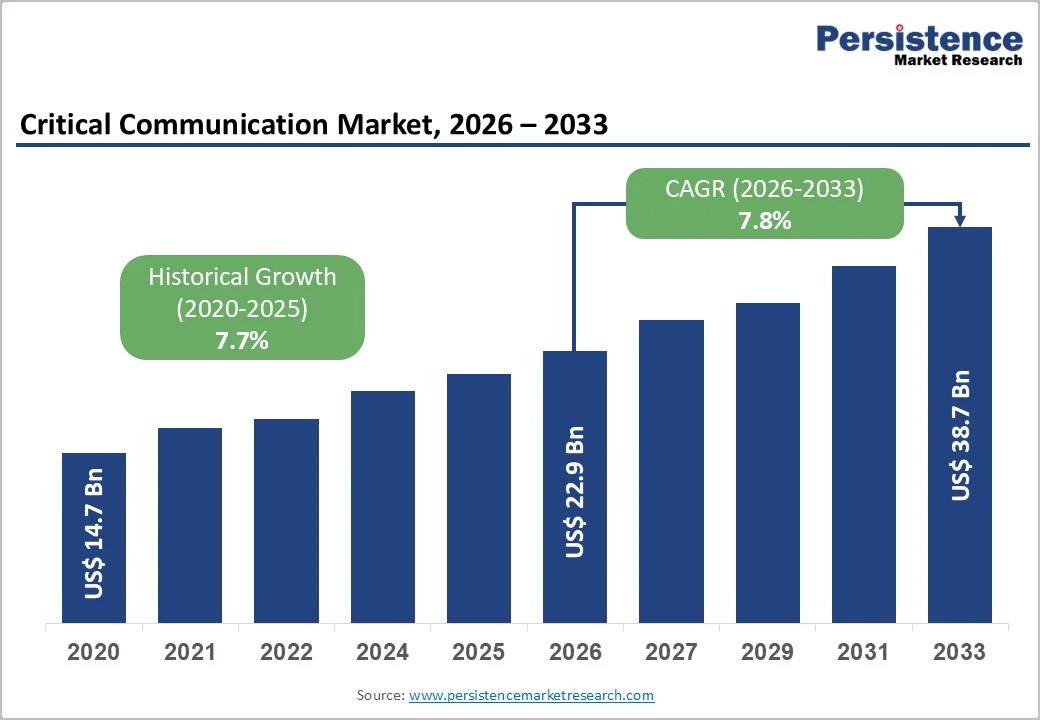
The global critical communication market is projected to grow from US$ 22.9 Bn in 2026 to US$ 38.7 Bn by 2033, at a CAGR of 7.8%, forecast 2033
BRENTFORD, ENGLAND, UNITED KINGDOM, January 29, 2026 /EINPresswire.com/ -- The critical communication market plays a foundational role in enabling secure, resilient, and real-time communication for organizations where failure is not an option. These systems are designed to support mission-critical operations across public safety, defense, transportation, utilities, energy, and large industrial facilities. Unlike commercial communication networks, critical communication platforms prioritize reliability, low latency, security, and interoperability even during extreme conditions such as natural disasters, cyberattacks, or infrastructure breakdowns.
In 2026, the global critical communication market size is estimated at US$ 22.9 billion and is projected to reach US$ 38.7 billion by 2033, expanding at a CAGR of 7.8% between 2026 and 2033. Market growth is strongly influenced by the increasing need for coordinated emergency response, government-led modernization of legacy networks, and the shift from traditional land mobile radio (LMR) systems to broadband-based LTE, 5G, and hybrid communication platforms. Among segments, public safety and government agencies dominate with nearly 50% market share, while North America leads geographically with around 40% share in 2026, driven by advanced infrastructure and sustained public safety investments.
𝐆𝐞𝐭 𝐚 𝐒𝐚𝐦𝐩𝐥𝐞 𝐏𝐃𝐅 𝐁𝐫𝐨𝐜𝐡𝐮𝐫𝐞 𝐨𝐟 𝐭𝐡𝐞 𝐑𝐞𝐩𝐨𝐫𝐭: https://www.persistencemarketresearch.com/samples/21004
Market Statistics, Growth Momentum, and Leading Segments
The steady expansion of the critical communication market reflects rising investments in digital infrastructure and heightened awareness of operational resilience. Governments and enterprises are prioritizing secure communication systems that ensure uninterrupted connectivity across dispersed teams and complex operational environments. Increasing urbanization, smart city initiatives, and large-scale transportation projects further amplify demand for mission-critical communication solutions.
From a segmentation perspective, public safety and government agencies remain the leading end-user group due to regulatory mandates, emergency preparedness programs, and nationwide public safety broadband initiatives. On the technology front, LTE-based and broadband-enabled mission-critical services are rapidly gaining traction as organizations seek higher data capacity, video streaming, and real-time situational awareness. Regionally, North America dominates the market due to early adoption of next-generation communication technologies, while Asia Pacific is emerging as the fastest-growing region, supported by infrastructure expansion and government-led digital transformation initiatives.
Market Segmentation Analysis
The critical communication market is segmented based on product type, technology, end-user, and deployment model, each contributing uniquely to overall market expansion. By product type, the market includes hardware (radios, base stations, network infrastructure), software (command-and-control platforms, dispatch solutions, analytics), and services (managed services, maintenance, system integration). While hardware continues to hold a substantial share due to ongoing infrastructure upgrades, software and managed services are witnessing faster growth as organizations focus on flexibility, interoperability, and lifecycle optimization.
From an end-user perspective, the market spans public safety and government, transportation and logistics, utilities, energy and mining, industrial enterprises, and defense sectors. Public safety remains the largest segment, supported by emergency response modernization and regulatory requirements. However, transportation and logistics are emerging as the fastest-growing end-user segment, driven by investments in rail networks, airports, ports, and intelligent traffic management systems that require real-time, mission-critical communication capabilities.
Technology Evolution and Deployment Trends
Technological evolution is at the core of the critical communication market’s transformation. Traditional LMR systems, long valued for their reliability, are increasingly being complemented or replaced by LTE and 5G-based mission-critical communication platforms. These broadband technologies enable advanced capabilities such as live video streaming, data sharing, location tracking, and enhanced situational awareness, which are essential for modern emergency and industrial operations.
Deployment models are also shifting toward hybrid architectures that integrate LMR with LTE, private cellular networks, and cloud-based platforms. This approach allows organizations to retain the reliability of legacy systems while leveraging the scalability and advanced features of broadband technologies. As cybersecurity risks grow, vendors are embedding robust encryption, authentication, and network redundancy features to ensure secure and resilient communication across all deployment environments.
Regional Insights
North America continues to dominate the critical communication market, supported by strong federal and state-level investments in public safety infrastructure. Large-scale initiatives to modernize emergency communication networks, coupled with early adoption of LTE and 5G technologies, position the region as a global leader. The presence of major technology providers and favorable regulatory frameworks further strengthens market growth.
Asia Pacific is expected to be the fastest-growing regional market during the forecast period. Rapid urbanization, expanding transportation infrastructure, and increasing government focus on disaster preparedness are key growth drivers. Countries across the region are investing heavily in digital public safety networks and smart infrastructure, creating significant opportunities for critical communication solution providers.
𝐃𝐨 𝐘𝐨𝐮 𝐇𝐚𝐯𝐞 𝐀𝐧𝐲 𝐐𝐮𝐞𝐫𝐲 𝐎𝐫 𝐒𝐩𝐞𝐜𝐢𝐟𝐢𝐜 𝐑𝐞𝐪𝐮𝐢𝐫𝐞𝐦𝐞𝐧𝐭? 𝐑𝐞𝐪𝐮𝐞𝐬𝐭 𝐂𝐮𝐬𝐭𝐨𝐦𝐢𝐳𝐚𝐭𝐢𝐨𝐧 𝐨𝐟 𝐑𝐞𝐩𝐨𝐫𝐭: https://www.persistencemarketresearch.com/request-customization/21004
Market Drivers
The critical communication market is driven by growing demand for secure, reliable, and real-time connectivity across mission-critical operations. Rising natural disasters, cyber threats, and emergency situations are pushing governments and enterprises to adopt resilient and interoperable communication systems. In parallel, modernization of legacy LMR networks toward LTE and 5G, supported by regulatory mandates on reliability and spectrum efficiency, is accelerating market growth.
Market Restraints
High deployment and integration costs remain a key challenge, especially for smaller organizations and developing regions. Interoperability issues between legacy systems and modern broadband platforms can delay implementation, while concerns around data security and privacy—particularly in cloud-based solutions—may limit adoption among cautious end-users.
Market Opportunities
Advancements in 5G-enabled mission-critical communication, private cellular networks, and cloud-based command platforms create strong growth opportunities. Emerging economies investing in smart infrastructure and national emergency networks further expand market potential, while partnerships and improving interoperability standards favor vendors offering scalable and secure solutions.
𝐁𝐮𝐲 𝐍𝐨𝐰 𝐭𝐡𝐞 𝐃𝐞𝐭𝐚𝐢𝐥𝐞𝐝 𝐑𝐞𝐩𝐨𝐫𝐭: https://www.persistencemarketresearch.com/checkout/21004
Company Insights
Motorola Solutions, Inc.
Nokia Corporation
Ericsson
Huawei Technologies Co., Ltd.
L3Harris Technologies, Inc.
Hytera Communications Corporation
Thales Group
Airbus Defence and Space
Samsung Electronics
ZTE Corporation
Conclusion
The critical communication market is entering a transformative phase as organizations worldwide recognize the strategic importance of resilient, secure, and interoperable communication systems. Driven by public safety modernization, technological convergence, and rising infrastructure risks, the market is poised for sustained growth through 2033. Vendors that align innovation with reliability and interoperability will be best positioned to capitalize on expanding opportunities across both developed and emerging markets.
Related Reports:
AI Sales Assistant Software Market
Pooja Gawai
Persistence Market Research
+1 646-878-6329
email us here
Visit us on social media:
LinkedIn
Instagram
Facebook
YouTube
Legal Disclaimer:
EIN Presswire provides this news content "as is" without warranty of any kind. We do not accept any responsibility or liability for the accuracy, content, images, videos, licenses, completeness, legality, or reliability of the information contained in this article. If you have any complaints or copyright issues related to this article, kindly contact the author above.
