

The Rapid Rise of Computer Aided Engineering in the Era of Smart Manufacturing
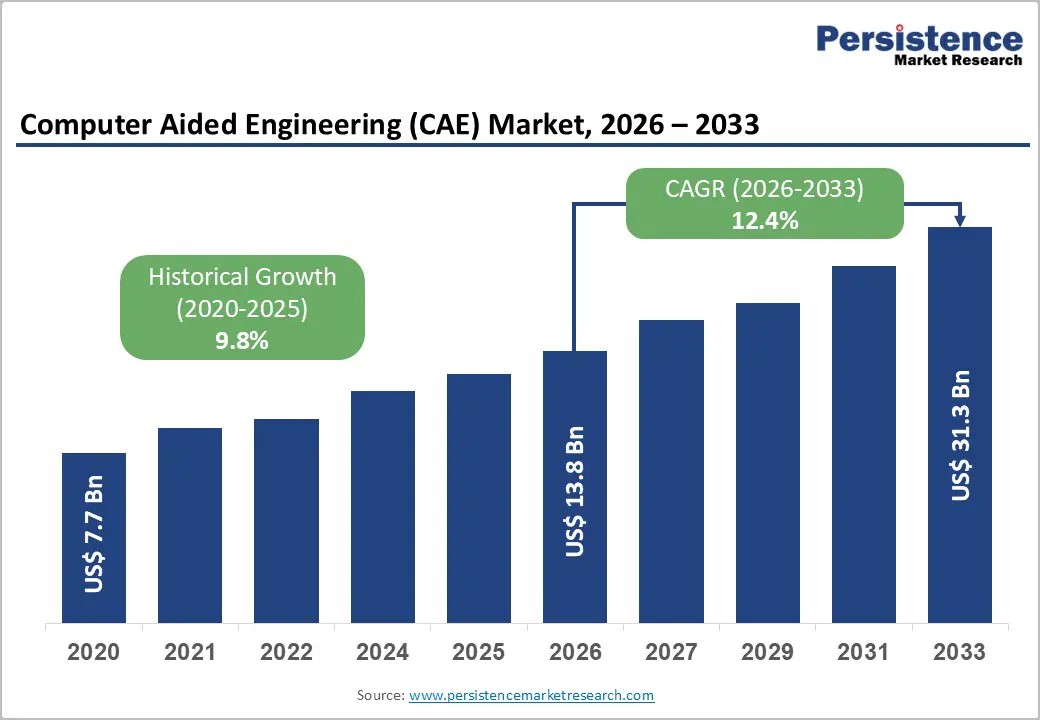
The computer aided engineering (CAE) market forecast to grow from US$ 13.8 Bn in 2026 to US$ 31.3 Bn by 2033, expanding at a strong 12.4% CAGR
BRENTFORD, ENGLAND, UNITED KINGDOM, January 29, 2026 /EINPresswire.com/ -- The Computer Aided Engineering (CAE) market has evolved into a critical pillar of modern product development, enabling engineers to simulate, validate, and optimize designs before physical production. CAE tools are widely used for structural analysis, computational fluid dynamics (CFD), thermal simulations, and multiphysics modeling, helping organizations reduce costs and accelerate time-to-market. As industries push toward smarter, lighter, and more sustainable products, CAE has shifted from a niche engineering solution to an enterprise-wide digital capability.
Globally, the CAE market size is expected to reach US$ 13.8 billion in 2026 and is forecast to expand to US$ 31.3 billion by 2033, registering a strong CAGR of 12.4% from 2026 to 2033. This growth is primarily driven by rising digital transformation across manufacturing, aerospace & defense, automotive, and healthcare sectors. Among segments, software dominates with nearly 74% share, while North America leads geographically with around 36% share, supported by high R&D spending, early adoption of advanced simulation tools, and strict regulatory requirements.
𝐆𝐞𝐭 𝐚 𝐒𝐚𝐦𝐩𝐥𝐞 𝐏𝐃𝐅 𝐁𝐫𝐨𝐜𝐡𝐮𝐫𝐞 𝐨𝐟 𝐭𝐡𝐞 𝐑𝐞𝐩𝐨𝐫𝐭: https://www.persistencemarketresearch.com/samples/33627
Key Highlights from the CAE Market Report
The global CAE market is projected to more than double in value between 2026 and 2033.
North America remains the leading region due to strong aerospace and automotive adoption.
CAE software accounts for the largest revenue share driven by multiphysics simulation demand.
Automotive & transportation is the dominant end-use industry with extensive EV development.
Cloud-based and AI-integrated CAE solutions are reshaping traditional simulation workflows.
Market Segmentation Analysis
The CAE market is primarily segmented by product type, which includes software and services. CAE software holds the dominant share as enterprises increasingly invest in integrated platforms that combine finite element analysis (FEA), CFD, and electromagnetic simulation. These solutions enable virtual prototyping, performance optimization, and compliance testing, significantly reducing physical testing costs. Continuous upgrades, subscription-based licensing, and cloud-native deployments further strengthen software adoption.
From an end-user industry perspective, the market spans automotive & transportation, aerospace & defense, electronics & semiconductors, healthcare, energy, and industrial manufacturing. Automotive & transportation leads the segment, accounting for nearly 28% of the market, driven by crash simulation, lightweight material design, and electric vehicle platform development. Meanwhile, aerospace and defense continue to rely heavily on CAE for safety-critical simulations and regulatory validation.
Regional Insights and Market Dynamics
North America dominates the global CAE market, supported by a mature engineering ecosystem and strong presence of leading CAE software vendors. The region benefits from high investments in aerospace, defense, and advanced automotive R&D, where simulation accuracy and regulatory compliance are non-negotiable. The early adoption of AI-driven and cloud-based CAE platforms further strengthens its market position.
East Asia represents the fastest-growing regional market, holding approximately 22% share, fueled by China’s automotive manufacturing expansion and semiconductor investments. Japan and South Korea are also accelerating CAE adoption as part of broader smart manufacturing and Industry 4.0 initiatives. Europe remains a steady contributor, particularly in automotive engineering, renewable energy, and industrial automation applications.
𝐃𝐨 𝐘𝐨𝐮 𝐇𝐚𝐯𝐞 𝐀𝐧𝐲 𝐐𝐮𝐞𝐫𝐲 𝐎𝐫 𝐒𝐩𝐞𝐜𝐢𝐟𝐢𝐜 𝐑𝐞𝐪𝐮𝐢𝐫𝐞𝐦𝐞𝐧𝐭? 𝐑𝐞𝐪𝐮𝐞𝐬𝐭 𝐂𝐮𝐬𝐭𝐨𝐦𝐢𝐳𝐚𝐭𝐢𝐨𝐧 𝐨𝐟 𝐑𝐞𝐩𝐨𝐫𝐭: https://www.persistencemarketresearch.com/request-customization/33627
Market Drivers Fueling CAE Adoption
One of the strongest drivers of the CAE market is the growing need to reduce product development cycles while maintaining high design accuracy. Virtual simulations allow companies to identify design flaws early, reducing costly physical prototyping and rework. This advantage is especially critical in industries with complex products and strict safety standards.
Another major growth driver is the integration of artificial intelligence, machine learning, and high-performance computing into CAE platforms. These technologies enable faster simulations, automated optimization, and real-time digital twin capabilities, making CAE indispensable for next-generation engineering and smart manufacturing strategies.
Market Restraints Limiting Growth Potential
Despite strong growth prospects, the CAE market faces challenges related to high initial implementation costs. Advanced CAE software licenses, coupled with the need for powerful computing infrastructure, can be prohibitive for small and mid-sized enterprises. This cost barrier often delays adoption in price-sensitive markets.
Additionally, the shortage of skilled simulation engineers poses a restraint. Effective use of CAE tools requires deep domain expertise and training, which can limit the full utilization of advanced features. Integration complexities with legacy systems further add to implementation challenges.
Market Opportunities Shaping the Future
The rapid adoption of cloud-based CAE solutions presents a significant opportunity for market expansion. Cloud deployment reduces upfront infrastructure costs and allows scalable simulation capabilities, making CAE accessible to a broader user base. This shift is particularly attractive for startups and mid-sized manufacturers.
Another promising opportunity lies in the expansion of CAE applications beyond traditional manufacturing. Healthcare device design, renewable energy systems, and smart infrastructure projects increasingly rely on simulation-driven engineering, opening new revenue streams for CAE vendors across emerging industries.
𝐁𝐮𝐲 𝐍𝐨𝐰 𝐭𝐡𝐞 𝐃𝐞𝐭𝐚𝐢𝐥𝐞𝐝 𝐑𝐞𝐩𝐨𝐫𝐭: https://www.persistencemarketresearch.com/checkout/33627
Reasons to Buy the CAE Market Report
✔ Gain in-depth insights into market size, growth trends, and long-term forecasts through 2033.
✔ Understand key drivers, restraints, and opportunities shaping the CAE industry landscape.
✔ Identify high-growth segments and emerging application areas across industries.
✔ Analyze regional performance and investment hotspots in developed and emerging markets.
✔ Benchmark leading companies and track recent strategic developments in the market.
Company Insights
ANSYS, Inc.
Siemens Digital Industries Software
Dassault Systèmes
Altair Engineering Inc.
Autodesk, Inc.
Hexagon AB
MSC Software (Hexagon)
Recent Developments:
Leading CAE vendors are increasingly integrating generative AI and machine learning capabilities to automate simulation workflows and design optimization.
Major players have expanded cloud-based CAE offerings through strategic partnerships with hyperscale cloud service providers to enhance scalability and collaboration.
Conclusion
The Computer Aided Engineering (CAE) market is entering a high-growth phase, driven by digital transformation, advanced simulation technologies, and the rising complexity of modern products. With strong demand from automotive, aerospace, and emerging sectors, CAE is no longer just a design support tool but a strategic enabler of innovation. As cloud, AI, and digital twin technologies mature, the CAE market is well-positioned to play a central role in shaping the future of engineering and industrial development worldwide.
Related Reports:
Point-to-Multipoint Microwave Backhaul Market
Mobile Value Added Services Market
Pooja Gawai
Persistence Market Research
+1 646-878-6329
email us here
Legal Disclaimer:
EIN Presswire provides this news content "as is" without warranty of any kind. We do not accept any responsibility or liability for the accuracy, content, images, videos, licenses, completeness, legality, or reliability of the information contained in this article. If you have any complaints or copyright issues related to this article, kindly contact the author above.
