

Global RFID Tags Market Growth Fueled by IoT and Real-Time Tracking Demand
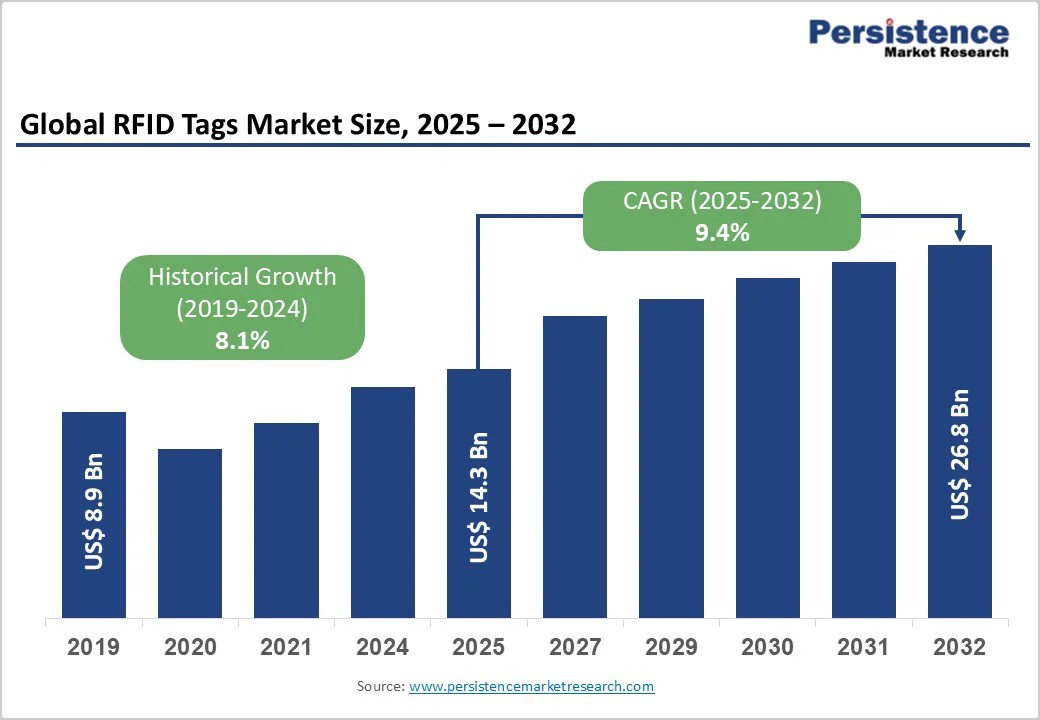
The RFID tags market is valued at US$14.3 Bn in 2025 and projected to reach US$26.8 Bn by 2032, growing strongly at a CAGR of 9.4% during 2025–2032 worldwide
BRENTFORD, ENGLAND, UNITED KINGDOM, January 28, 2026 /EINPresswire.com/ -- The RFID Tags Market is gaining strong traction as industries focus on automation, real-time visibility, and data-driven operations. RFID tags enable wireless tracking without line-of-sight scanning, making them a major upgrade over traditional barcodes in modern supply chains.
In 2025, the global RFID Tags market is valued at US$ 14.3 billion and is projected to reach US$ 26.8 billion by 2032, growing at a CAGR of 9.4%. Growth is driven by rising adoption across retail, healthcare, logistics, and manufacturing for improved accuracy and traceability.
Increasing demand for supply chain efficiency, asset tracking, and inventory optimization is fueling market expansion, supported by IoT and cloud integration. Passive RFID tags lead due to cost advantages, while North America dominates the market and Asia Pacific emerges as the fastest-growing region.
𝐆𝐞𝐭 𝐚 𝐒𝐚𝐦𝐩𝐥𝐞 𝐏𝐃𝐅 𝐁𝐫𝐨𝐜𝐡𝐮𝐫𝐞 𝐨𝐟 𝐭𝐡𝐞 𝐑𝐞𝐩𝐨𝐫𝐭: https://www.persistencemarketresearch.com/samples/22402
RFID Tags Market Segmentation Analysis
The RFID Tags market is segmented based on product type, frequency, application, and end-user industry. By product type, the market is categorized into passive, active, and semi-passive RFID tags. Passive RFID tags hold the dominant share due to their low manufacturing cost, longer lifespan, and suitability for large-scale inventory and retail applications. Active RFID tags, while more expensive, are gaining traction in high-value asset tracking and real-time location systems.
Based on frequency, the market is divided into low frequency (LF), high frequency (HF), and ultra-high frequency (UHF) tags. UHF RFID tags lead the segment owing to their longer read range and faster data transmission, making them ideal for logistics, warehousing, and supply chain applications. HF RFID tags continue to see steady demand in access control, smart cards, and payment systems.
From an end-user perspective, the RFID Tags market spans retail, healthcare, logistics and transportation, manufacturing, aerospace, agriculture, and government sectors. Retail remains the largest end-user, driven by demand for inventory accuracy, theft prevention, and omnichannel fulfillment. Healthcare is emerging as a high-growth segment as hospitals adopt RFID for patient tracking, equipment monitoring, and medication safety.
Regional Insights and Market Dynamics
North America continues to dominate the RFID Tags market due to early adoption of advanced identification technologies and strong investments in retail automation and healthcare digitization. The U.S. leads regional growth, supported by favorable regulations, strong R&D capabilities, and widespread implementation of RFID in inventory management and asset tracking systems.
Asia Pacific is the fastest-growing regional market, driven by rapid industrialization, expanding e-commerce, and government-backed smart infrastructure projects. Countries such as China, India, and Japan are investing heavily in manufacturing automation, logistics optimization, and smart city initiatives, significantly boosting RFID tag deployment across multiple industries.
𝐃𝐨 𝐘𝐨𝐮 𝐇𝐚𝐯𝐞 𝐀𝐧𝐲 𝐐𝐮𝐞𝐫𝐲 𝐎𝐫 𝐒𝐩𝐞𝐜𝐢𝐟𝐢𝐜 𝐑𝐞𝐪𝐮𝐢𝐫𝐞𝐦𝐞𝐧𝐭? 𝐑𝐞𝐪𝐮𝐞𝐬𝐭 𝐂𝐮𝐬𝐭𝐨𝐦𝐢𝐳𝐚𝐭𝐢𝐨𝐧 𝐨𝐟 𝐑𝐞𝐩𝐨𝐫𝐭: https://www.persistencemarketresearch.com/request-customization/22402
Market Drivers Fueling RFID Tags Adoption
One of the strongest drivers of the RFID Tags market is the growing need for real-time supply chain visibility. As global supply chains become more complex, businesses require accurate tracking solutions to minimize disruptions, reduce losses, and improve delivery timelines. RFID tags enable seamless monitoring of goods across warehouses, transportation routes, and retail shelves.
The rapid growth of the retail and e-commerce sector is another major driver. Retailers are increasingly adopting RFID technology to enhance inventory accuracy, prevent stockouts, and support omnichannel strategies. RFID-enabled systems significantly reduce manual labor and improve operational efficiency, making them a preferred choice over traditional barcode solutions.
Market Restraints Limiting Industry Growth
Despite its strong growth outlook, the RFID Tags market faces certain challenges. High initial implementation costs, including RFID readers, software, and system integration, can act as a barrier for small and medium-sized enterprises. For cost-sensitive markets, this upfront investment can delay adoption despite long-term benefits.
Data security and privacy concerns also restrain market growth, particularly in applications involving personal or sensitive information. Unauthorized access, data breaches, and regulatory compliance issues require robust security frameworks, increasing system complexity and cost. These challenges may slow adoption in sectors with strict data protection requirements.
Emerging Market Opportunities
The integration of RFID tags with IoT, AI, and cloud computing platforms presents significant growth opportunities. Smart RFID solutions enable predictive analytics, automated alerts, and real-time decision-making, transforming traditional tracking systems into intelligent business tools. This convergence is opening new revenue streams across smart logistics, smart retail, and industrial automation.
Emerging applications in healthcare, agriculture, and smart cities further expand market potential. RFID-enabled patient monitoring, livestock tracking, and urban infrastructure management are gaining traction globally. As governments and enterprises invest in digital transformation initiatives, demand for advanced RFID tagging solutions is expected to surge.
𝐁𝐮𝐲 𝐍𝐨𝐰 𝐭𝐡𝐞 𝐃𝐞𝐭𝐚𝐢𝐥𝐞𝐝 𝐑𝐞𝐩𝐨𝐫𝐭: https://www.persistencemarketresearch.com/checkout/22402
Company Insights
• Avery Dennison Corporation
• NXP Semiconductors
• Zebra Technologies Corporation
• Alien Technology
• Impinj Inc.
• HID Global Corporation
• Honeywell International Inc.
• Smartrac Technology Group
• GAO RFID Inc.
Conclusion: The Future of the RFID Tags Market
The RFID Tags market is entering a phase of accelerated growth as businesses worldwide embrace automation, digital visibility, and intelligent tracking solutions. With strong demand from retail, healthcare, logistics, and manufacturing, RFID technology is becoming a foundational component of modern operational ecosystems.
Advancements in IoT integration, declining tag costs, and expanding use cases in smart infrastructure will continue to fuel market expansion. As North America maintains leadership and Asia Pacific emerges as a high-growth hub, the global RFID Tags market is well-positioned to deliver long-term value for technology providers, enterprises, and investors alike.
Related Reports:
Data Integration Software Market
Sales Engagement Platform Market
Pooja Gawai
Persistence Market Research
+1 646-878-6329
email us here
Visit us on social media:
LinkedIn
Instagram
Facebook
YouTube
Legal Disclaimer:
EIN Presswire provides this news content "as is" without warranty of any kind. We do not accept any responsibility or liability for the accuracy, content, images, videos, licenses, completeness, legality, or reliability of the information contained in this article. If you have any complaints or copyright issues related to this article, kindly contact the author above.
