

Metabolic Testing Market to Reach US$1,280.7 Mn by 2033 | Persistence Market Research
metabolic testing market
Analysis of global metabolic testing market covering products, technologies, applications, regional trends, growth drivers, challenges, and competitive outlook.
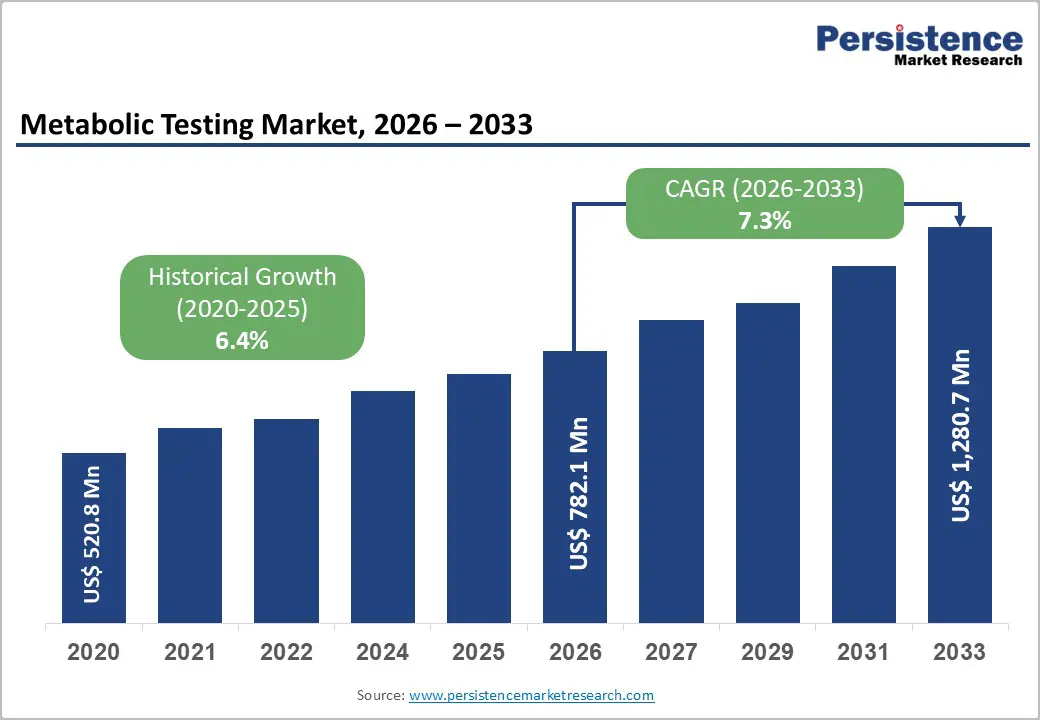
LONDON, UNITED KINGDOM, January 26, 2026 /EINPresswire.com/ -- The global metabolic testing market is poised for steady expansion, driven by rising chronic disease prevalence, digital healthcare adoption, and advances in diagnostic technologies. The market is projected to grow from US$ 782.1 Mn in 2026 to US$ 1,280.7 Mn by 2033, registering a compound annual growth rate (CAGR) of 7.3% during the forecast period. This growth reflects the increasing importance of metabolic assessment in early diagnosis, disease monitoring, and personalized healthcare across both developed and emerging economies.
Download Your Free Sample & Explore Key Insights: https://www.persistencemarketresearch.com/samples/4446
Market Size and Key Trends
Metabolic testing plays a critical role in evaluating metabolic disorders such as diabetes, obesity, and cardiovascular diseases. The integration of advanced analytics, interoperable laboratory information systems, and telehealth platforms has significantly improved testing efficiency and accessibility. North America currently dominates the global market, supported by advanced healthcare infrastructure, strict regulatory standards, and high adoption of routine metabolic screening. Meanwhile, Asia-Pacific is the fastest-growing region, fueled by expanding healthcare facilities, government-led digital health initiatives, and rising patient awareness about metabolic health.
Key Industry Highlights
By product, metabolic carts represent the dominant segment, accounting for 44.1% of the market share. Their widespread use in clinical exercise testing, cardiopulmonary assessments, and resting metabolic rate evaluations is driven by high accuracy, reproducibility, and compatibility with digital monitoring systems. Regionally, North America leads with a 45.0% market share, while Asia-Pacific shows the highest growth potential due to increasing investments in diagnostic laboratories, software, and services. Market growth is primarily driven by the rising burden of diabetes and obesity, demand for early diagnosis, advances in assay technologies, and integration of digital health monitoring systems. Significant opportunities are emerging in point-of-care testing, AI-enabled diagnostics, multiplex metabolic panels, personalized disease management, and telehealth-enabled testing models.
Market Dynamics
A major driver of the metabolic testing market is the rising prevalence of metabolic disorders worldwide. Conditions such as diabetes, obesity, and cardiovascular diseases require continuous diagnosis and monitoring. In India, large-scale studies have shown diabetes prevalence exceeding 11%, with millions more affected by pre-diabetes, obesity, and hypertension. Globally, diabetes prevalence among adults has nearly doubled over recent decades, reflecting lifestyle-related risk factors such as elevated body mass index and sedentary behavior. Regular metabolic testing enables clinicians to detect abnormalities in glucose tolerance, lipid profiles, and cardiovascular risk markers, supporting effective disease management and prevention strategies.
Despite strong demand, inconsistent reimbursement policies remain a key restraint. Reimbursement rates for metabolic tests vary widely across regions and payers, often failing to cover actual testing costs. In the United States, differences between Medicare, Medicaid, and private insurance coverage, along with reimbursement cuts under policies such as the Protecting Access to Medicare Act, have pressured laboratory revenues. In many low- and middle-income countries, limited public insurance coverage forces patients to pay out of pocket, restricting access to essential metabolic diagnostics and slowing market adoption.
Get Custom Insights Designed for Your Business: https://www.persistencemarketresearch.com/request-customization/4446
Emerging Opportunities
The development of portable and point-of-care metabolic testing solutions presents a significant growth opportunity. These devices enable rapid, decentralized testing in hospitals, clinics, and home settings, reducing turnaround time and improving clinical decision-making. Point-of-care glucose monitoring, in particular, has seen rapid adoption as innovations bring laboratory-quality assays into compact, user-friendly formats. With more than 537 million adults globally living with diabetes, accessible metabolic testing tools support better chronic disease management and expand the market’s reach beyond traditional laboratory environments.
Category-wise Analysis
By product, metabolic carts dominate the market due to their ability to provide precise, real-time measurements of energy expenditure, oxygen consumption, and carbon dioxide production. Indirect calorimetry using these systems is considered the clinical gold standard for determining caloric needs and guiding nutrition therapy. By technology, resting metabolic rate (RMR) analysis leads the market, as it measures the largest component of daily energy expenditure and supports personalized nutrition planning, obesity management, and metabolic disorder treatment with higher accuracy than predictive equations.
Regional Insights
North America’s leadership in the metabolic testing market is supported by established laboratory networks, regulatory standards such as CLIA, and a high burden of chronic disease that drives routine screening. Europe remains a key market due to universal healthcare systems, strong regulatory oversight, and public health initiatives emphasizing preventive diagnostics. Asia-Pacific is the fastest-growing region, with hundreds of millions affected by type 2 diabetes and metabolic syndrome, alongside expanding healthcare infrastructure and government-backed screening programs that address significant unmet diagnostic needs.
Checkout Now & Download Complete Market Report: https://www.persistencemarketresearch.com/checkout/4446
Competitive Landscape and Recent Developments
The metabolic testing market is moderately consolidated, with leading players focusing on advanced assay development, AI-enabled analysis, and regulatory compliance. Strategic collaborations with healthcare institutions and research organizations support innovation and market expansion. Recent developments include FDA clearance for advanced cardiorespiratory diagnostic software and major contracts supporting deployment of monitoring solutions, reflecting continued investment in accuracy, scalability, and compliance. Key companies operating in the market include CareFusion Corporation, General Electric Company, Geratherm Medical AG, MGC Diagnostics Corporation, OSI Systems, COSMED, and several other specialized diagnostic technology providers.
Metabolic Testing Market Segmentation
By Product
CPET Systems
Metabolic Carts
Body Consumption Analyzers
ECGs/EKGs Attachable to CPET Systems
Software
By Technology
VO2 Max Analysis
RMR Analysis
Body Composition Analysis
By Application
Lifestyle Diseases
Critical Care
Human Performance Testing
Dysmetabolic Syndrome X
Metabolic Disorders
Others
By End User
Hospitals
Laboratories
Sports Training Centers
Gyms
Others
By Region
North America
Europe
East Asia
South Asia & Oceania
Latin America
Middle East and Africa
Read Related Reports:
Hepatitis C Treatment Market: Global hepatitis C treatment market will rise from US$9.8 Bn in 2025 to US$12.7 Bn by 2032 at 3.8% CAGR, driven by high-efficacy DAAs offering 95%+ cure rates.
Cutaneous and Systemic Leishmaniasis Market: The Cutaneous & Systemic Leishmaniasis market, valued at US$376.4 million in 2025, is projected to reach US$459.8 million by 2032, growing at a 2.9% CAGR.
Persistence Market Research
Persistence Market Research Pvt Ltd
+1 646-878-6329
email us here
Visit us on social media:
LinkedIn
Instagram
Facebook
YouTube
X
Legal Disclaimer:
EIN Presswire provides this news content "as is" without warranty of any kind. We do not accept any responsibility or liability for the accuracy, content, images, videos, licenses, completeness, legality, or reliability of the information contained in this article. If you have any complaints or copyright issues related to this article, kindly contact the author above.
