

Office-Based Lab Market to Reach US$45.6Bn by 2033 | Persistence Market Research
Office-Based Lab Market
Office-based lab market is expanding as healthcare shifts to decentralized, cost-efficient, patient-focused diagnostic and interventional care today
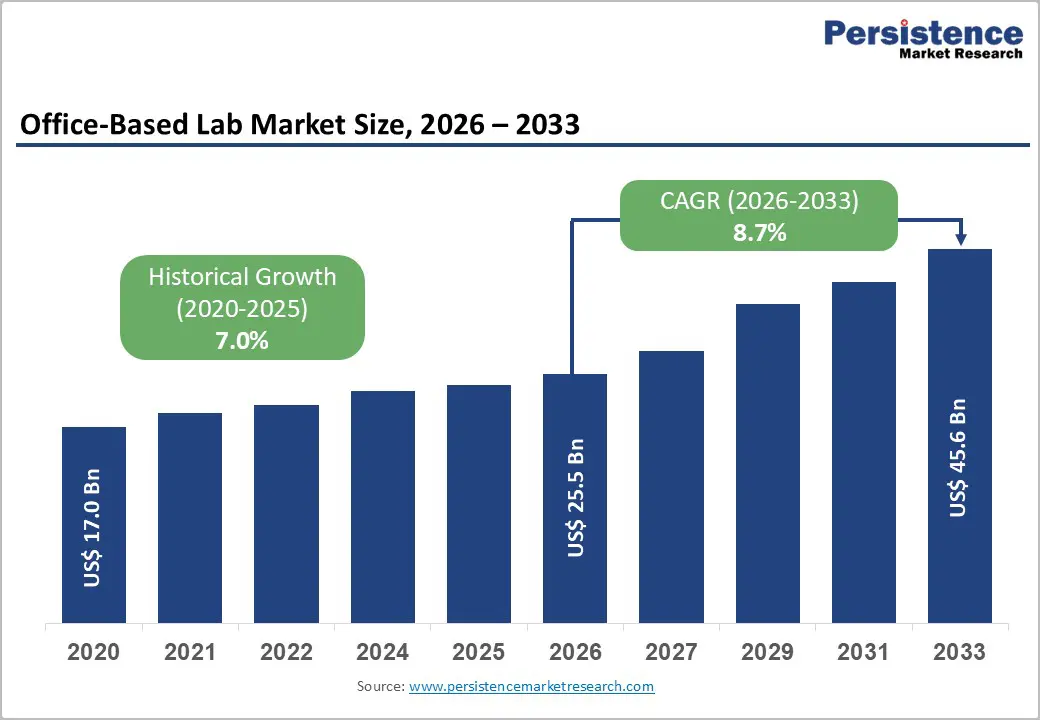
LONDON, UNITED KINGDOM, January 22, 2026 /EINPresswire.com/ -- The global office-based lab (OBL) market is entering a phase of sustained expansion as healthcare systems worldwide accelerate the shift toward decentralized, cost-efficient care delivery models. The market is expected to be valued at US$ 25.5 billion in 2026 and is projected to reach US$ 45.6 billion by 2033, registering a compound annual growth rate (CAGR) of 8.7% during the forecast period. This growth builds on steady historical expansion of 7.0% between 2020 and 2025, underscoring the structural importance of office-based labs in modern healthcare infrastructure.
Download Your Free Sample & Explore Key Insights: https://www.persistencemarketresearch.com/samples/31553
Key Growth Drivers
Rising prevalence of chronic and cardiovascular diseases remains the primary catalyst for OBL market growth. Cardiovascular diseases account for over 30% of global mortality among aging populations, while peripheral arterial disease affects approximately 7% of adults in developed economies. Aging demographics, sedentary lifestyles, and increasing obesity rates continue to intensify demand for diagnostic and interventional services. Office-based labs provide a clinically effective and economically viable alternative to hospital-based care, particularly for minimally invasive vascular and cardiovascular procedures. Physicians increasingly prefer dedicated office-based facilities that allow higher procedural control, operational efficiency, and improved patient throughput.
Escalating healthcare expenditures further support market expansion. Governments and private healthcare providers are investing heavily in decentralized diagnostic and interventional infrastructure to reduce system-wide costs and hospital dependency. Office-based models align closely with value-based care initiatives by lowering overhead expenses, reducing inpatient admissions, and improving patient experience. Favorable reimbursement policies and regulatory support in key markets are enabling physician offices and clinics to expand in-house diagnostic capabilities, driving broader adoption of office-based labs.
Market Restraints
Despite strong growth prospects, high capital investment requirements pose a significant barrier to market entry. Establishing office-based labs requires substantial upfront expenditure on advanced imaging systems, diagnostic analyzers, interventional devices, and compliance infrastructure. Ongoing maintenance costs, skilled workforce requirements, and quality assurance obligations further pressure operational margins. Smaller and independent practices often face financial constraints that limit their ability to compete with hospital systems and large reference laboratories benefiting from economies of scale.
Regulatory complexity also restrains market expansion. Office-based labs must comply with stringent frameworks governed by agencies such as the FDA, CMS, and CDC, including Clinical Laboratory Improvement Amendments (CLIA) certification requirements. Navigating varying levels of test complexity, maintaining continuous compliance, and managing regulatory updates demand dedicated resources. These burdens disproportionately affect smaller providers, contributing to market consolidation among larger, well-capitalized organizations.
Get Custom Insights Designed for Your Business: https://www.persistencemarketresearch.com/request-customization/31553
Emerging Opportunities
Point-of-care testing (POCT) and decentralized diagnostics represent a major growth opportunity for the OBL market. Accelerated adoption during the COVID-19 pandemic demonstrated the clinical and operational advantages of rapid, on-site testing. Expansion of POCT into areas such as infectious diseases, autoimmune disorders, and antimicrobial resistance is creating new revenue streams for office-based labs. Regulatory expansion of CLIA-waived tests has lowered entry barriers for minimal-complexity testing, enabling broader participation by physician practices. Integration of POCT with telemedicine platforms further enhances the value proposition of office-based labs by supporting real-time clinical decision-making and expanding access in underserved regions.
Emerging markets also present significant long-term opportunities. Asia Pacific, Latin America, and the Middle East & Africa are witnessing rapid healthcare infrastructure development driven by medical tourism, rising healthcare spending, and government-led decentralization initiatives. Lower capital and operational costs in these regions enable faster facility expansion, while large patient populations and rising chronic disease prevalence create strong procedural demand.
Regional Insights
North America leads the global OBL market with 39% share in 2025, supported by advanced healthcare infrastructure, high chronic disease prevalence, and favorable reimbursement frameworks. The presence of major medical device manufacturers and supportive regulatory policies continues to drive innovation and adoption. Asia Pacific is the fastest-growing region, fueled by healthcare modernization in China, India, and Japan, expanding medical tourism, and government initiatives promoting decentralized diagnostics. Large underserved populations and rising cardiovascular disease incidence position the region as the primary growth engine through 2033.
Checkout Now & Download Complete Market Report: https://www.persistencemarketresearch.com/checkout/31553
Companies Covered in Office-Based Lab Market
Panasonic Corporation
Duracell
Energizer Holdings, Inc.
GP Batteries International Limited
Spectrum Brands Holdings, Inc.
FDK Corporation
Highpower International, Inc.
Huanyu Battery Co., Ltd.
Primearth EV Energy Co., Ltd.
Ansmann AG.
Varta AG
Uniross
GS Yuasa International Ltd.
NEXcell Battery Company
BYD Company Limited
Competitive Landscape
The office-based lab market is highly competitive, featuring global medical device manufacturers, outpatient care providers, and diagnostic service companies. Competition centers on technology innovation, procedural efficiency, and integrated solutions. Strategic partnerships and acquisitions remain common as companies seek to strengthen market presence. Notably, in June 2023, Royal Philips partnered with BIOTRONIK to expand cardiovascular device offerings for office-based lab customers, highlighting continued investment and collaboration across the sector.
Market Segmentation
Set-up Model
Single Specialty
Multi-specialty
Hybrid
Service Type
Peripheral Vascular Intervention
Interventional Radiology
Endovascular Therapy
Cardiovascular
Venous
Non-vascular
Specialist Type
Vascular Surgeons
Interventional Cardiologists
Interventional Radiologists
Others
End User Type
Physician offices
Clinics
Research institutions
Others
Regions
North America
Europe
East Asia
South Asia & Oceania
Latin America
Middle East & Africa
Read Related Reports:
Direct Endoscopic Necrosectomy Market: Direct Endoscopic Necrosectomy market to grow from US$ 262.2 Mn in 2026 to US$ 494.9 Mn by 2033 at 9.5% CAGR, driven by advanced imaging adoption.
Insomnia Treatment Market: Global insomnia treatment market to grow from US$3.1 Bn in 2026 to US$3.8 Bn by 2033, driven by rising stress, sleep disorders, and mental health awareness..
Persistence Market Research
Persistence Market Research Pvt Ltd
+1 646-878-6329
email us here
Visit us on social media:
LinkedIn
Instagram
Facebook
YouTube
X
Legal Disclaimer:
EIN Presswire provides this news content "as is" without warranty of any kind. We do not accept any responsibility or liability for the accuracy, content, images, videos, licenses, completeness, legality, or reliability of the information contained in this article. If you have any complaints or copyright issues related to this article, kindly contact the author above.
