

Life Science Software Market In 2029
Life Science Software Global Market Report 2026 – Market Size, Trends, And Forecast 2026-2035
Life Science Software Global Market Report 2026 – Market Size, Trends, And Forecast 2026-2035

Life Science Software Global Market Report 2026 – Market Size, Trends, And Forecast 2026-2035
The Business Research Company’s Life Science Software Global Market Report 2026 – Market Size, Trends, And Forecast 2026-2035
LONDON, GREATER LONDON, UNITED KINGDOM, January 9, 2026 /EINPresswire.com/ -- Life Science Software Market to Surpass $31 billion in 2029. In comparison, the Software Services market, which is considered as its parent market, is expected to be approximately $2,407 billion by 2029, with Life Science Software to represent around 1% of the parent market. Within the broader Information Technology industry, which is expected to be $12,711 billion by 2029, the Life Science Software market is estimated to account for nearly 0.2% of the total market value.
Which Will Be the Biggest Region in the Life Science Software Market in 2029
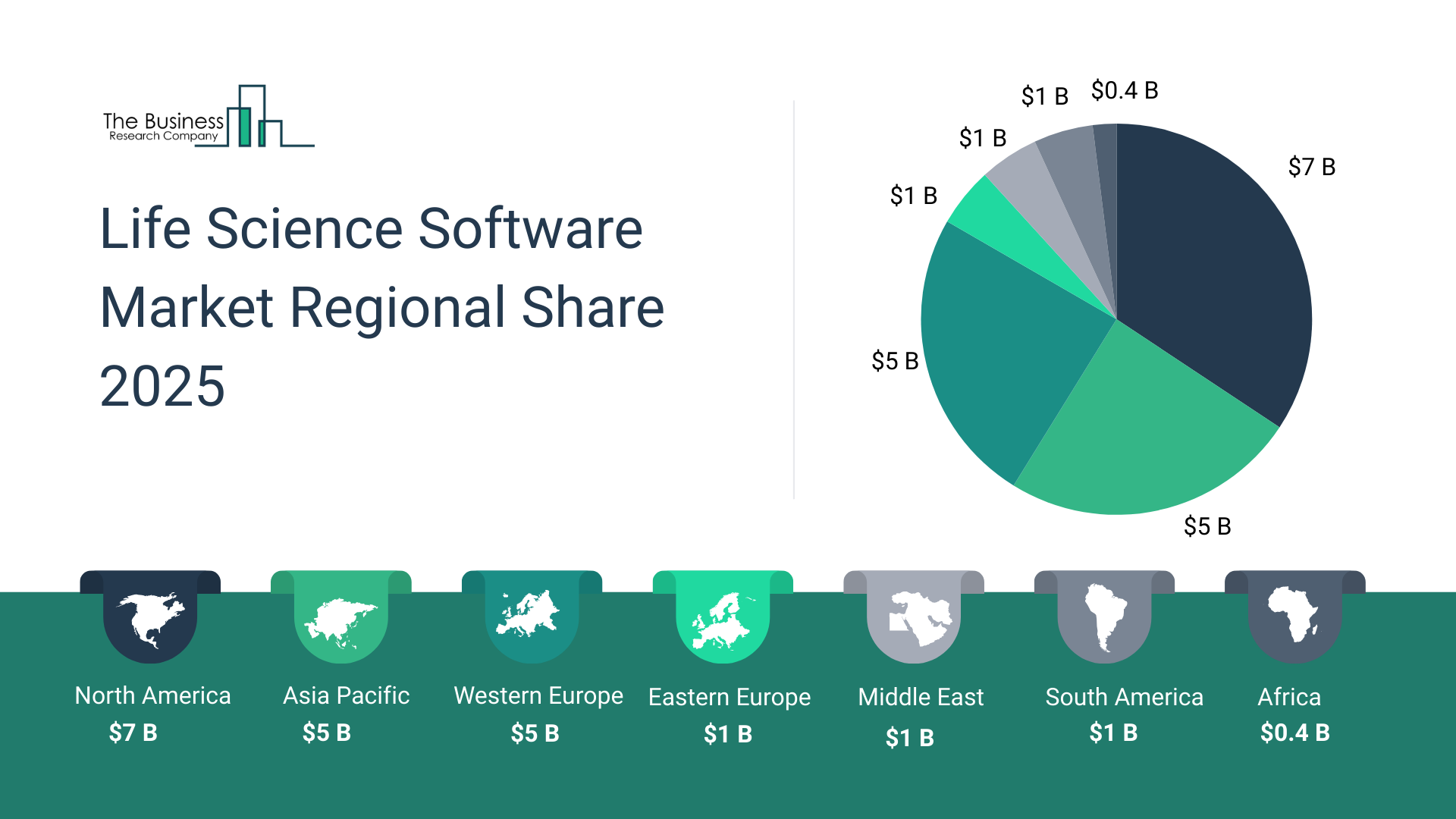
North America will be the largest region in the life science software market in 2029, valued at $10,620 million. The market is expected to grow from $6,818 million in 2024 at a compound annual growth rate (CAGR) of 9%. The strong growth can be attributed to the expansion of the pharmaceutical sector and rising prevalence of chronic diseases.
Which Will Be The Largest Country In The Global Life Science Software Market In 2029?
The USA will be the largest country in the life science software market in 2029, valued at $9,387 million. The market is expected to grow from $5,979 million in 2024 at a compound annual growth rate (CAGR) of 9%. The strong growth can be attributed to the expansion of the pharmaceutical sector and rising prevalence of chronic diseases.
Request a free sample of the Life Science Software Market report:
https://www.thebusinessresearchcompany.com/sample_request?id=13690&type=smp
What will be Largest Segment in the Life Science Software Market in 2029?
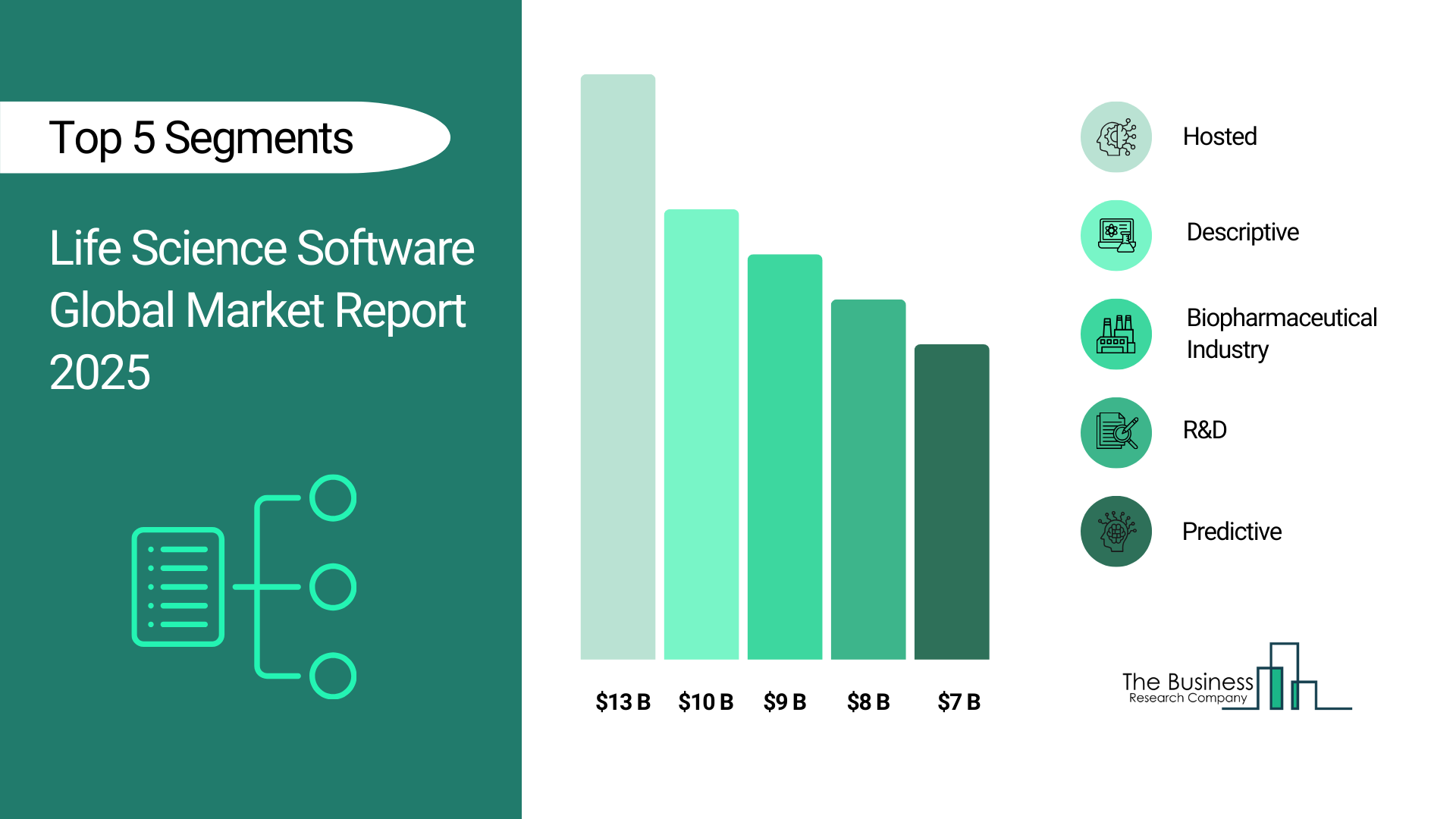
The life science software market is segmented by type into predictive, descriptive and prescriptive. The descriptive market will be the largest segment of the life science software market segmented by type, accounting for 50% or $15,381 million of the total in 2029. The descriptive market will be supported by rising demand for analysing historical healthcare data for patterns and trends, increasing need for compliance monitoring through accurate record-keeping, growing adoption in clinical data management, expanding use in quality assurance and regulatory reporting, rising demand for performance benchmarking in healthcare institutions, enhanced pharmaceutical sales monitoring and the use of descriptive analytics for tracking pharmacovigilance activities.
The life science software market is segmented by deployment into on-premises and hosted. The hosted market will be the largest segment of the life science software market segmented by deployment, accounting for 70% or $21,594 million of the total in 2029. The hosted market will be supported by increasing preference for scalable and cost-effective deployment models, growing adoption among small and medium-sized enterprises, reduced burden of IT maintenance and upgrades, faster implementation timelines, rising acceptance of remote access and collaboration needs, enhanced disaster recovery and backup capabilities and flexibility to adapt to changing business needs. This is highly reasonable due to advantages in scalability, cost-effectiveness (shifting from CapEx to OpEx), easier collaboration, and faster deployment of updates. It is the unequivocal driver of overall market growth.
The life science software market is segmented by application into marketing, compliance, R&D, pharmacovigilance and SCM. The R&D market will be the largest segment of the life science software market segmented by application, accounting for 42% or $13,074 million of the total in 2029. The R&D market will be supported by rising complexity of clinical trials and research studies, growing need for faster drug development timelines, increasing collaboration among global research institutions, enhanced focus on analyzing large-scale biological datasets, rising costs of drug discovery pushing efficiency demands, growing application of simulation models and the need for streamlined laboratory management systems. Software is critical for drug discovery, clinical trial management, genomic sequencing, and leveraging AI for novel research. It reflects the industry's core focus on innovation.
The life science software market is segmented by end user into healthcare institutes, biopharmaceutical industry, medical devices industry and medical research centers. The biopharmaceutical industry market will be the largest segment of the life science software market segmented by end user, accounting for 48% or $14,730 million of the total in 2029. The biopharmaceutical industry market will be supported by rising complexity of drug discovery and clinical trials, increasing focus on personalized medicine development, growing global demand for new therapies, stricter regulatory requirements in drug development, expanding collaborations between pharma companies and research centers, rising R&D expenditure by biotech firms and the need for efficiency in commercialization strategies. This aligns with the massive R&D investments and high profitability of this sector, allowing for significant software spend.
What is the expected CAGR for the Life Science Software Market leading up to 2029?
The expected CAGR for the life science software market leading up to 2029 is 11%.
What Will Be The Growth Driving Factors INThe Global Life Science Software Market In The Forecast Period?
The rapid growth of the global life science software market leading up to 2029 will be driven by the following key factors that are expected to reshape drug discovery, clinical research workflows, regulatory compliance, and laboratory operations worldwide.
Expansion Of The Pharmaceutical sector- The expansion of the pharmaceutical sector will become a key driver of growth in the life science software market by 2029. As pharmaceutical companies handle vast volumes of research and patient data, they require software for data integration, analysis and secure management. The rise in new drug pipelines and biologics further drives adoption of solutions that streamline processes and reduce time-to-market. Additionally, digital platforms enable collaboration across global research teams, enhancing efficiency and innovation in pharmaceutical development. As a result, the expansion of the pharmaceutical sector is anticipated to contributing to a 1.3% annual growth in the market.
Rising Prevalence Of Chronic Diseases - The rising prevalence of chronic diseases will emerge as a major factor driving the expansion of the life science software market by 2029. The growing prevalence of chronic diseases such as cancer, diabetes and cardiovascular disorders is driving demand for advanced healthcare solutions. Managing these conditions requires large-scale data collection, analysis and patient monitoring, which can be efficiently handled through life science software. Such platforms support clinical research, personalized treatment planning and drug development. As healthcare providers and researchers seek more effective ways to manage long-term diseases, adoption of life science software continues to accelerate. Consequently, the accelerating rising prevalence of chronic diseases capabilities is projected to contributing to a 1.0% annual growth in the market.
Rising Demand For Real-World Evidence (RWE) And Data - The rising demand for real-world evidence (RWE) and data processes will serve as a key growth catalyst for the life science software market by 2029. The growing demand for real-world evidence (RWE) and real-world data is driving the adoption of life science software, as organizations need advanced platforms to collect, manage and analyze large-scale patient and healthcare data. Regulators and payers increasingly require RWE to assess drug safety, effectiveness and value in real-world settings. This pushes pharmaceutical and biotech companies to invest in digital tools that ensure accurate insights and compliance. As a result, life science software plays a critical role in accelerating decision-making and supporting evidence-based healthcare outcomes. Therefore, this rising demand for real-world evidence (RWE) and data operations is projected to supporting to a 0.5% annual growth in the market.
Rising Demand For Cloud Adoption In Medtech - The rising demand for cloud adoption in medtech will become a significant driver contributing to the growth of the life science software market by 2029. The growing adoption of cloud technologies in medtech is boosting the life science software market by enabling secure, scalable and cost-efficient data management. Cloud platforms allow seamless integration of large and complex datasets, supporting advanced analytics, real-time collaboration and remote access. This improves efficiency in clinical trials, research and regulatory compliance. Additionally, cloud adoption helps medtech companies accelerate innovation and enhance patient-centric digital solutions. Consequently, the rising demand for cloud adoption in medtech strategies is projected to contributing to a 0.3% annual growth in the market.
Access the detailed Life Science Software Market report here:
https://www.thebusinessresearchcompany.com/report/life-science-software-global-market-report
What Are The Key Growth Opportunities In The Life Science Software Market in 2029?
The most significant growth opportunities are anticipated in the life science descriptive analytics software market, the hosted life science software market, the life science R&D software market and the life science software for biopharmaceuticals market. Collectively, these segments are projected to contribute over $30 billion in market value by 2029, driven by increasing adoption of digital platforms for drug discovery, rising demand for integrated R&D workflows, and the growing need for real-time data analysis and regulatory compliance across the biopharmaceutical and healthcare sectors. This surge reflects the accelerating adoption of advanced life science software solutions that enable faster decision-making, enhanced research efficiency, and improved operational outcomes, fueling transformative growth within the broader life science software industry.
The hosted life science software market is projected to grow by $10,204 million, the life science software for biopharmaceuticals market by $6,986 million, the life science descriptive analytics software market by $6,586 million, and the life science R&D software market by $6,031 million over the next five years from 2024 to 2029.
The Business Research Company (www.thebusinessresearchcompany.com) is a leading market intelligence firm renowned for its expertise in company, market, and consumer research. We have published over 17,500 reports across 27 industries and 60+ geographies. Our research is powered by 1,500,000 datasets, extensive secondary research, and exclusive insights from interviews with industry leaders.
We provide continuous and custom research services, offering a range of specialized packages tailored to your needs, including Market Entry Research Package, Competitor Tracking Package, Supplier & Distributor Package and much more
Disclaimer: Please note that the findings, conclusions and recommendations that TBRC Business Research Pvt Ltd delivers are based on information gathered in good faith from both primary and secondary sources, whose accuracy we are not always in a position to guarantee. As such TBRC Business Research Pvt Ltd can accept no liability whatever for actions taken based on any information that may subsequently prove to be incorrect. Analysis and findings included in TBRC reports and presentations are our estimates, opinions and are not intended as statements of fact or investment guidance.
The Business Research Company
Americas +1 310-496-7795
Europe +44 7882 955267
Asia & Others +44 7882 955267 & +91 8897263534
Email: info@tbrc.info"
Oliver Guirdham
The Business Research Company
+44 7882 955267
info@tbrc.info
Legal Disclaimer:
EIN Presswire provides this news content "as is" without warranty of any kind. We do not accept any responsibility or liability for the accuracy, content, images, videos, licenses, completeness, legality, or reliability of the information contained in this article. If you have any complaints or copyright issues related to this article, kindly contact the author above.
